
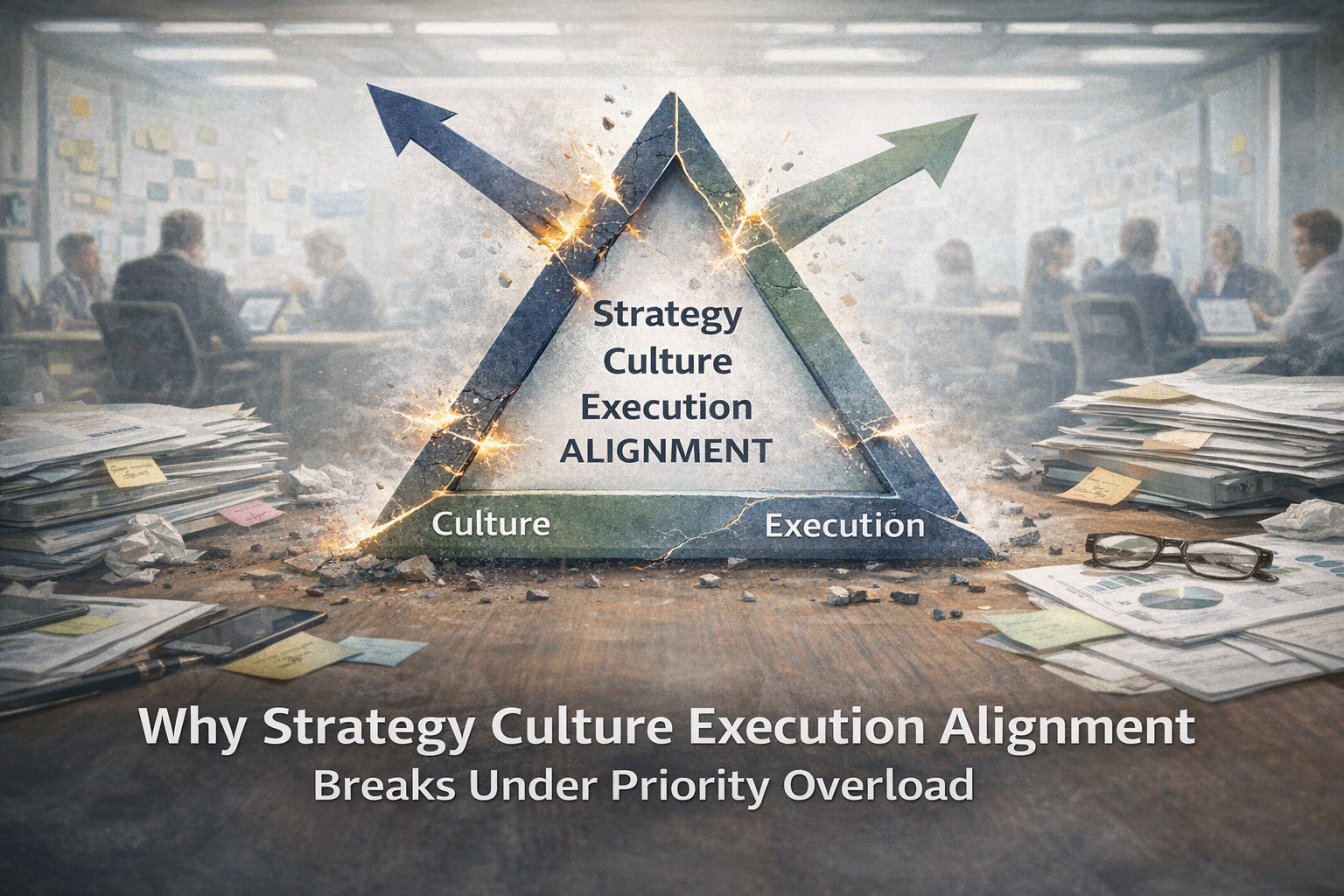
Leadership teams often believe that organisational success depends mainly on having a strong strategy. New opportunities appear, new markets emerge, and new ideas promise improvement. Each initiative seems valuable and worthy of attention.
However, organisations rarely struggle because they lack ideas. More often, they struggle because too many ideas compete for attention at once.
A common pattern appears when strategy expands faster than the organisation’s ability to execute. Leaders introduce new initiatives, projects, and priorities without reducing existing commitments. Over time, the organisation becomes overloaded. This overload weakens the strategy, culture, and execution alignment.
Execution systems that once supported clear priorities begin to stretch. Teams attempt to manage more work than their systems were designed to carry. Culture adapts by becoming reactive, and attention becomes fragmented.
The Klaen Tension Triangle provides a useful lens for understanding this pattern. It shows how organisations lose balance when strategy expands faster than their execution capacity.
Understanding this relationship helps leaders recognise why organisations sometimes feel busy yet fail to gain momentum.
Every organisation operates within limits. These limits include time, attention, people and operational systems.
Strategy defines what the organisation wants to achieve. Execution determines how much work can realistically be carried out at one time. Strategy, culture, and execution alignment exist when strategic ambition remains connected to execution capacity.
When strategy expands without regard for capacity alignment, it weakens. Teams attempt to deliver many initiatives simultaneously, even though their systems were designed for fewer priorities.
Execution becomes strained. People attempt to respond to every request, yet progress slows because attention is divided across too many activities. The organisation becomes busy without becoming more productive.
This is one of the clearest signals that strategy, culture, and execution alignment has weakened.
Strategy expansion usually begins with positive intentions. Leaders see opportunities that could improve the organisation. They may consider entering new markets, launching improvement programmes or introducing new products. Each idea appears sensible when viewed on its own.
The difficulty appears when these ideas accumulate faster than the organisation can execute them. Leadership teams add initiatives without removing existing priorities. Over time, the list of priorities grows longer. Execution systems that once supported focus must now carry a growing number of initiatives.
Attention becomes divided.
Projects compete for time and resources.
The organisation begins to move in many directions at once.
Execution capacity represents the practical ability of an organisation to deliver results. It includes leadership attention, team resources and operational systems.
Every organisation has a natural limit to the number of initiatives it can carry. Leadership meetings can review only a certain number of priorities. Teams can manage only a limited number of projects before attention becomes fragmented. When strategy expands faster than execution capacity, priority overload appears.
Instead of concentrating effort on a few meaningful initiatives, the organisation attempts to carry out many priorities simultaneously. Execution slows because attention is repeatedly divided. Momentum begins to disappear.
Organisations do not slow down because people work less. They slow down because too many priorities compete for attention.

When execution capacity is exceeded, people respond in predictable ways. Meetings multiply as leaders attempt to track progress across many initiatives. Status reporting increases because managers need more information to monitor competing projects. Teams become reactive because priorities shift frequently. Work slows down because attention is divided across too many tasks.
These behaviours are not signs of weak effort. They are natural responses to the loss of strategy, culture, and execution alignment. The organisation is attempting to manage more priorities than its systems can support.
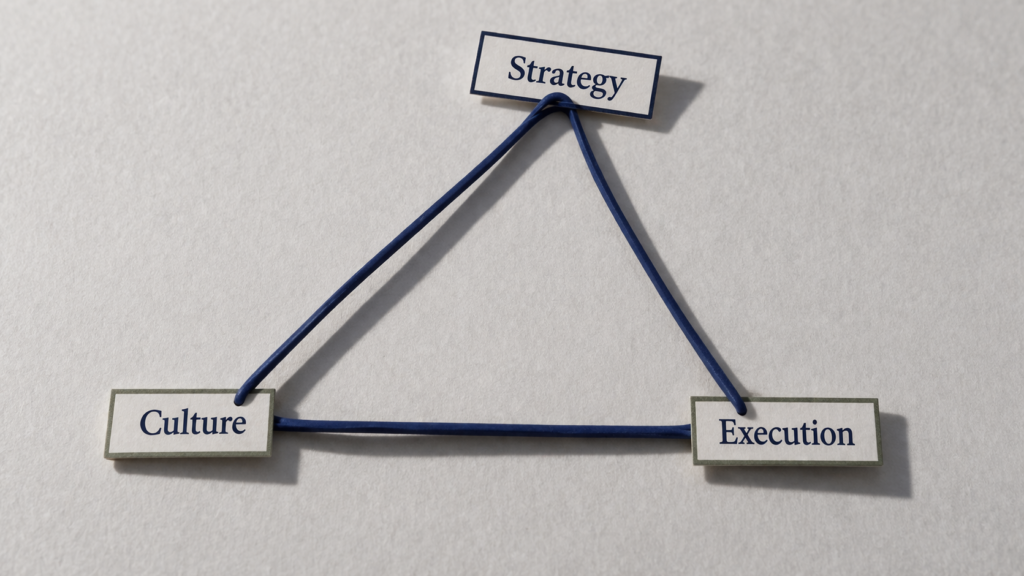
The Klaen Tension Triangle explains how organisations maintain balance between strategy, culture, and execution.
When the triangle is balanced, strategy defines direction, culture supports behaviour and execution systems convert priorities into results.
When strategy expands faster than execution capacity, the triangle becomes distorted. Strategy pulls outward as new initiatives appear. Execution struggles to keep pace. Culture adapts by becoming reactive.
Instead of reinforcing focus, culture begins to signal that every initiative is important. When everything appears important, nothing receives enough attention to succeed. The organisation becomes busy without increasing momentum.
Culture plays a powerful role in how organisations respond to priority overload.
When leadership continues adding initiatives without removing others, teams begin to assume that every request must be addressed immediately. People hesitate to prioritise because they believe every initiative is equally important.
The cultural message becomes clear even if it is never stated directly. Everything matters. Yet when everything matters, focus disappears. Teams divide their attention across multiple priorities and struggle to deliver meaningful progress.
Restoring strategy, culture, and execution alignment requires leaders to redefine focus.

Leadership teams play a central role in maintaining alignment between strategy, culture and execution.
When new opportunities appear, leaders must not only consider the value of the initiative but also the organisation’s capacity to deliver it. Adding initiatives without removing others creates pressure across execution systems.
Leaders, therefore, benefit from regularly asking three simple questions.
These questions help restore strategy, culture, and execution alignment and protect organisational focus.
Restoring strategy, culture, and execution Alignment
Priority overload rarely appears suddenly. It develops gradually as organisations add new strategic initiatives without adjusting execution capacity.
The Klaen Tension Triangle helps leaders recognise this pattern.
When strategy expands faster than execution capacity, the triangle stretches. Execution slows. Culture becomes reactive. Focus disappears.
Organisations rarely lose momentum because people lack effort or commitment. They lose momentum because attention is divided across too many priorities.
Restoring strategy, culture, and execution alignment reconnects strategic ambition with organisational capacity. When alignment returns, organisations regain clarity, focus and momentum. Progress becomes visible again because attention is no longer divided across competing priorities. The organisation begins moving forward in a single direction.
A Leadership Reflection
Leadership teams often ask what new initiatives should be added to the strategy.
An equally important question may be worth asking.
What should stop?
Take a moment to reflect on the relationship between strategy, culture and execution in your organisation.
The Klaen Tension Triangle offers a simple lens for exploring these questions and strengthening strategy, culture, and execution alignment.