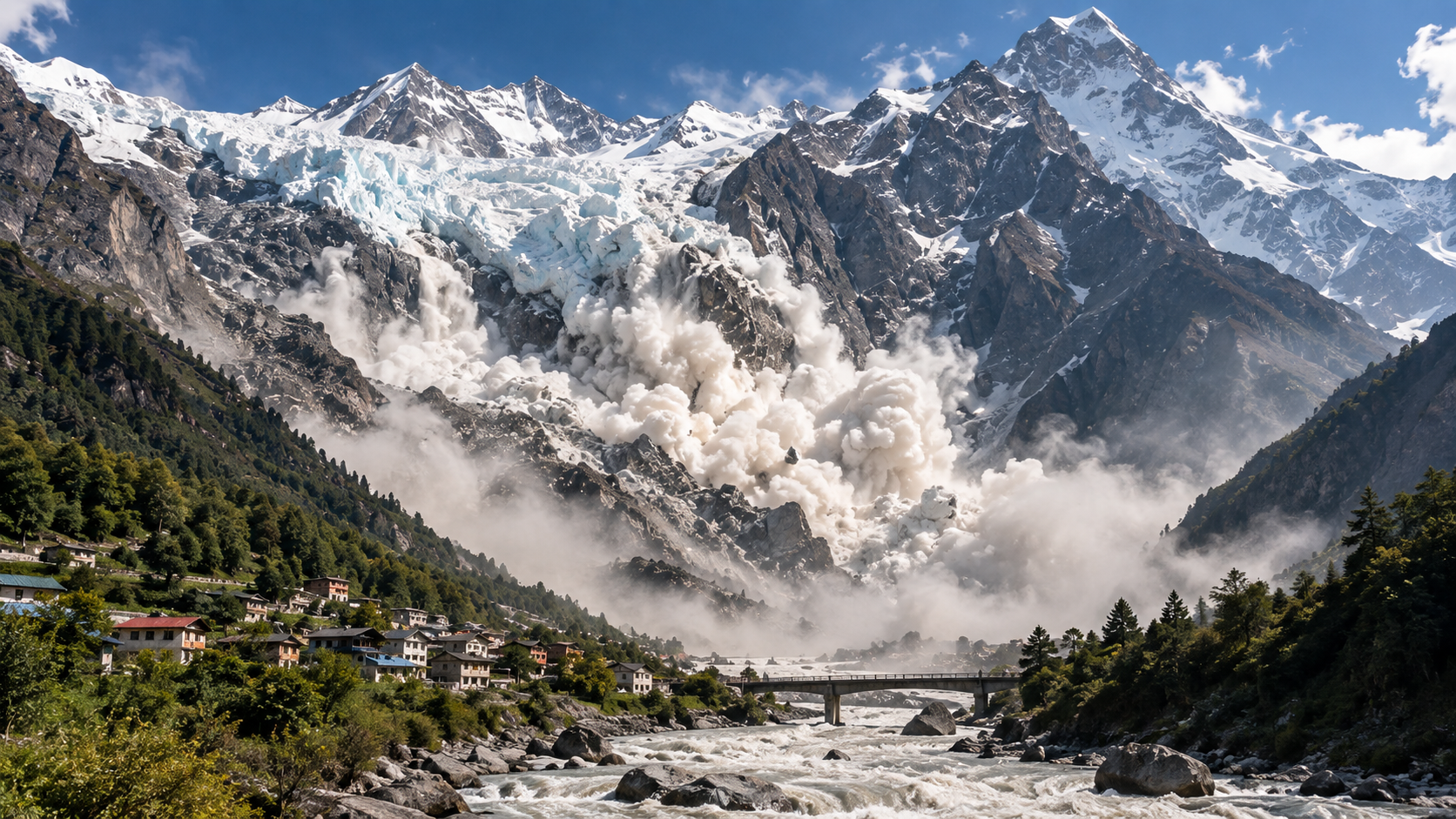
On 26 August 2026, a wall of water, mud, ice, and rock tore through the Bhote Koshi–Trishuli river system in Nepal. Villages disappeared. Roads, bridges, and hydropower facilities were destroyed. By 7 September, Nepal was observing a national day of mourning, with at least 1,380 people reported dead and more than 5,500 still missing across the disaster zone. The catastrophe began high in the Himalayas when a massive rock-and-ice collapse blocked a river system, and then it released a devastating surge downstream.
It is tempting to describe such an event as sudden and unforeseeable. In one sense, it was extraordinarily sudden. People living beside the river did not watch the water slowly rise over hours. The destructive surge moved faster than the conventional warning system was designed to handle.
But there is another, more uncomfortable truth.
In the days and weeks before the collapse, the mountain appears to have been sending signals. They were visible in satellite data. Researchers subsequently identified accelerating movement in the glacier-rock mass that would eventually fail. Satellite imagery taken shortly before the disaster showed brown meltwater near the failure zone and indications of cracking in the surrounding bedrock. Nature reported that analysis of satellite radar observations suggested that the movement in sections of rock and ice was accelerating in the weeks before the collapse.
These were not predictions saying, “A catastrophic flood will occur at 8:37 on Wednesday morning.” Science rarely provides that level of certainty in complex systems. They were something more subtle: evidence that the system was changing.
That distinction matters enormously.
It is also where the Nepal disaster becomes a powerful metaphor for what happens inside organisations.
The central argument of The Tension Triangle is that organisations rarely move from healthy to broken in a single dramatic moment. Before the visible failure, there is usually a period of drift. Direction becomes less clear. Trust changes. Work becomes harder. Individually, the signs may be small enough to explain away. Collectively, however, they tell us that the system is moving.
The satellite evidence was not part of an operational warning mechanism capable of continuously screening thousands of unstable Himalayan slopes and translating unusual movement into local evacuation decisions. Nature specifically noted this difficulty: current monitoring systems are generally not designed to continuously monitor thousands of glaciers and mountain slopes for subtle deformation. The hazard also sat in a transboundary region near Nepal and Tibet, making rapid information sharing between countries essential.
The conventional river-warning system had another problem. It was looking for the kind of flood it knew how to recognise.
At 8:40 on the morning of the disaster, the Rasuwagadhi gauge near the Chinese border measured the Bhote Koshi at only 1.62 metres, well below its warning threshold. That was its final reading. Before the next scheduled transmission, the station itself was destroyed. Downstream gauges suffered the same fate. The instruments recorded ordinary-looking water levels immediately before an extraordinary wall of debris arrived.
The system was measuring the river.
That is an extraordinary organisational metaphor.
Businesses often do exactly the same thing.
They monitor revenue. Profit. Sales. Customer numbers. Project completion. Staff turnover. Productivity. These indicators matter. But they are often the equivalent of the Nepalese river gauge. They tell leaders what is happening in the visible system.
Meanwhile, somewhere upstream, something may already be moving. People no longer challenge decisions openly. Priorities are interpreted differently by different executives. Managers quietly create workarounds. Meetings end without genuine agreement. Decisions take longer. Teams increasingly blame one another. Good employees begin protecting themselves rather than the organisation.
Work still gets done, but with more effort.
The financial gauge may still read 1.62 metres.
Everything appears safe. Yet the organisational mountain may already be moving.
This is the territory of the Tension Triangle.
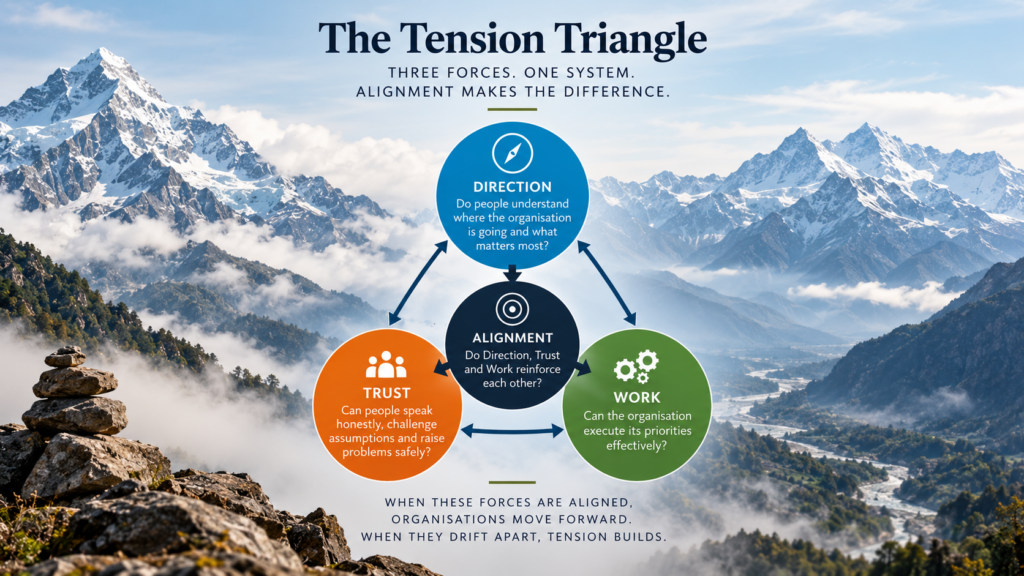
Direction asks whether people genuinely understand where the organisation is going, what matters most, and who has authority to decide. Trust asks whether information can move honestly through the system, particularly uncomfortable information. Work asks whether the organisation can actually turn intention into coordinated execution. And alignment asks whether these three remain connected rather than drifting apart.
The Direction problem was not that nobody understood floods. Nepal has substantial flood expertise. The deeper problem was that the dominant warning logic was designed around river levels, rainfall, and familiar hydrological patterns. The catastrophic event was generated by a high-mountain rock-and-ice collapse. Experts have since argued that Himalayan warning systems need to detect multiple hazards at their source, rather than waiting until the consequence appears in a downstream river gauge.
Organisations experience the same problem when their definition of risk becomes too narrow.
A board may believe the company is healthy because profit is strong. A CEO may believe a restructuring is working because costs are falling. An executive committee may believe employees support the strategy because nobody openly objects.
They are not necessarily looking at the wrong data.
Trust appears in the Nepal story in a different way: information had to cross organisational, geographic, and national boundaries quickly enough to be useful. The disaster exposed gaps between formal arrangements for cross-border cooperation and the ability to exchange actionable information at the speed required by the hazard. Nepal is now planning to strengthen monitoring and is seeking more real-time upstream information sharing.
Trust in organisations performs exactly this function.
A healthy organisation does not merely allow information to move downward from leaders. It allows weak, inconvenient, and ambiguous signals to move upward and sideways.
The question is not simply, “Do people trust one another?”
A more useful question is:
“Can bad news travel faster than the problem?”
If the answer is no, the organisation has a Trust problem even if everyone is polite.
Then there is Work: the operational machinery that converts awareness into action.
Nepal’s warning was eventually transmitted. Officials received information that a major surge had entered the Bhote Koshi and reportedly sent warnings downstream within minutes. But in parts of Rasuwa, the flood was already there. The issue was therefore not simply whether somebody communicated. It was whether the complete chain, detection, interpretation, communication, decision, and evacuation, could operate faster than the hazard itself.
A phone call reached an accountant connected to Tribhuvan Trishuli Secondary School. The warning was passed to headmaster Rajendra Dawadi. He did not wait for perfect information. He stopped incoming buses, sounded the alarm, and moved more than 900 students and 16 staff toward safety. They had approximately 14 minutes.
The school was later destroyed.
The children were not.
That story may be the most important part of the entire metaphor.
But for those fourteen minutes, Direction, Trust, and Work aligned.
There was Direction: the danger is coming; get to higher ground.
There was Trust: the headmaster believed the signal strongly enough to act before he could personally verify the flood.
And then there was Work: buses stopped, people moved, decisions were made, and the organisation executed.
That is alignment.
This is not an argument that every death could have been prevented. A catastrophe of this scale would have caused enormous destruction even with significantly better preparation. Some communities close to the source had only minutes, or perhaps less, to react. But experts examining the disaster have argued that farther downstream, where ten or more minutes were available, a sufficiently capable end-to-end warning system could have saved significant numbers of people.
The enormous losses among hydropower workers further demonstrate why warning cannot be separated from operational design. Around 900 workers were later reported missing from hydropower projects, with hundreds believed trapped in tunnels. Rescuers then confronted another weakness: Nepal had extensive expertise in constructing hydropower tunnels but much less capability for large-scale underground emergency rescue. Roads were destroyed, tunnel entrances buried, and specialised equipment was limited.
Again, the organisational parallel is uncomfortable.
Companies frequently invest heavily in the ability to operate under normal conditions and far less in the ability to respond when assumptions fail.
Then the unexpected event arrives.
The organisation discovers that efficiency and preparedness are not the same thing.
This is why the Tension Triangle should not be treated primarily as a model for fixing dysfunctional organisations.
The question is not, “Are we failing?”
By the time the answer is clearly yes, the water may already be coming down the valley.
The better questions are:
And most importantly:
What are we explaining away because the headline numbers still look normal?

Nepal gives us a vivid image of organisational drift.
At 8:40 that morning, the gauge said 1.62 metres.
Nothing in that number announced catastrophe.
Yet high above the river, the system was already failing.
This is the danger leaders face when they rely primarily on lagging indicators. Results often deteriorate after the underlying organisational conditions have changed. People may feel the change before leaders can see it in the numbers. Small tensions in Direction, Trust and Work may therefore be the organisational equivalent of accelerating rock, discoloured meltwater, and a growing crack in the mountain.
None proves that disaster is coming. But together they deserve attention.
The lesson of Nepal is therefore not that every weak signal predicts catastrophe. That would create constant alarm and paralysis.
The lesson is that weak signals become valuable when someone has created a system for connecting them.
That is what alignment does.
The tragedy of 26 August reminds us that there is a profound difference between an early sign and an early warning.
A warning reaches someone who understands its meaning, believes it matters, has authority to respond and can mobilise others before the consequences arrive.
That is true in a Himalayan valley.
It is equally true in a boardroom.
The most dangerous moment in an organisation may therefore not be when the numbers collapse. It may be months earlier, when the first cracks appear, and everyone can still explain them away.
The flood is visible at the end. The drift begins much earlier.
And that is precisely why leaders need to learn to see it before it breaks.
At your next leadership meeting, try asking just one question:
“What are we noticing now that doesn’t look serious yet, but could be telling us that something is beginning to drift?”
Don’t rush to solve it. Listen to what people see from different parts of the organisation.
Sometimes the most valuable leadership conversation begins before anyone believes there is a problem.