Picture a team that ticks every box. The numbers are steady. Everyone turns up on time. Meetings run smoothly and end with a clear decision. From the outside, nothing looks wrong at all.
But inside, something has shifted. Decisions take a little longer than they used to. People agree quickly in a meeting, then quietly disagree once they’re back at their own desks. Good people are still working hard, but progress is slower, and the work feels heavier than it should. And nobody can fully explain why.
This is the exact problem the Tension Triangle was built to explain. It isn’t a checklist. It isn’t a set of rules to follow in order. It’s a way of seeing why teams that look healthy on the surface can be slowly coming apart underneath, long before any result proves it.
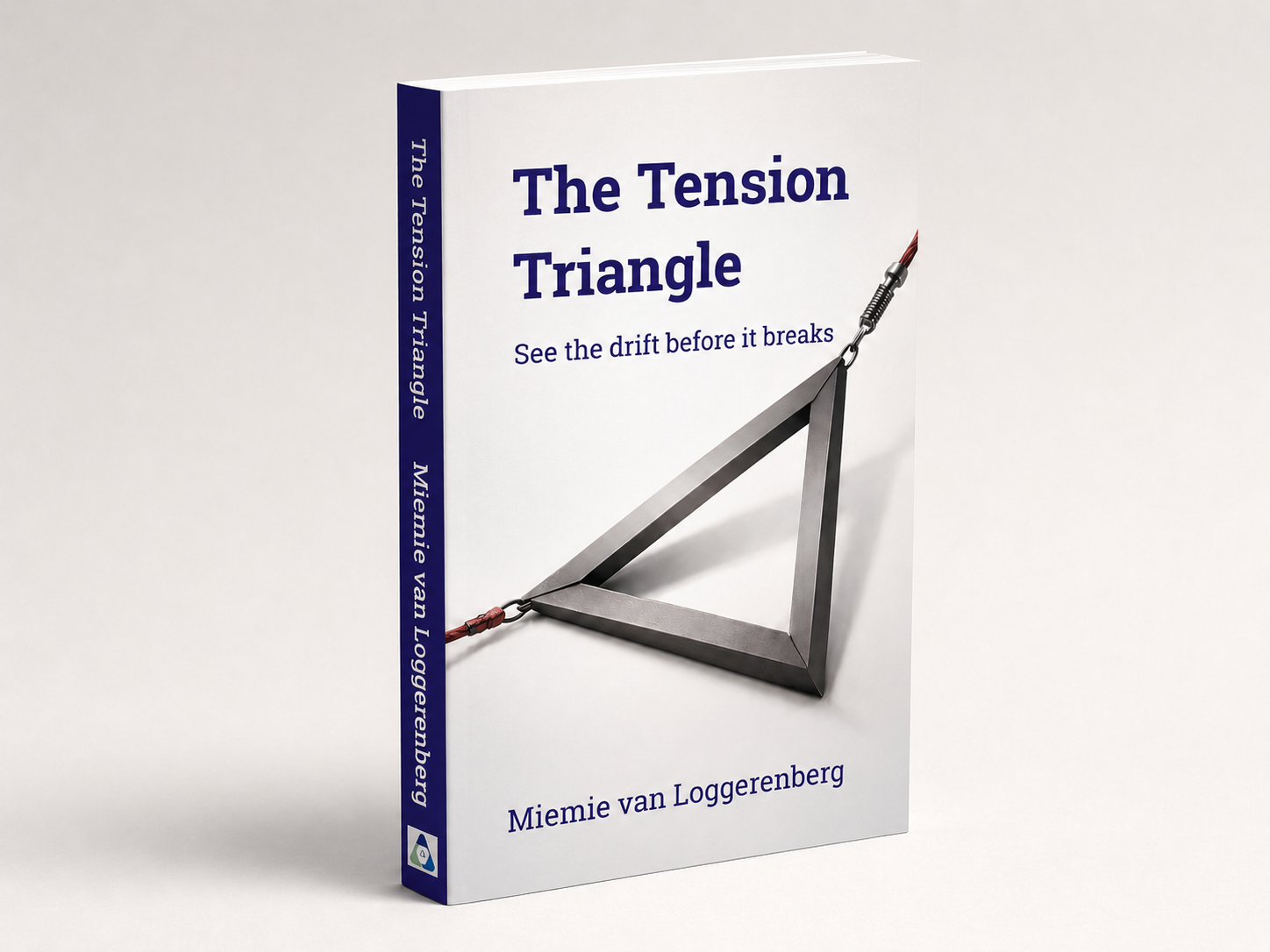
The idea comes from a book called The Tension Triangle, written by Miemie van Loggerenberg, an educational psychologist and business coach. Rather than teaching through lectures, the book teaches through stories, because a story tends to stick in your memory in a way that good advice rarely does. One of the clearest stories in the whole book is about a valley full of wagon makers, and it explains the Tension Triangle better than any diagram ever could.
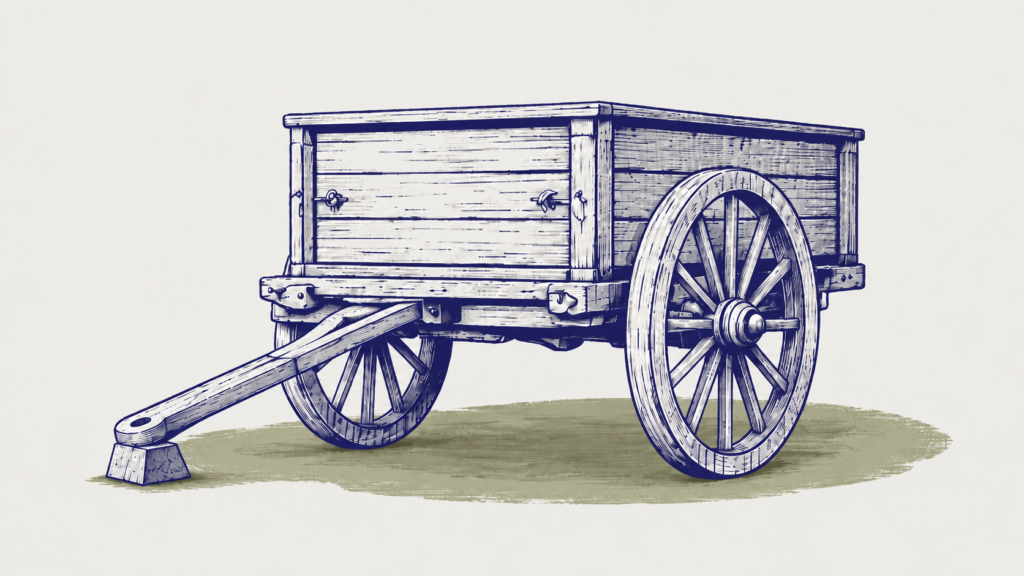
In a quiet valley, a workshop of wagon makers had built a strong reputation. People trusted their wagons the way you trust something that has never let you down. Then, one autumn, the complaints began. One traveller said his wagon had pulled to one side for the whole journey. Another said his wagon had rattled, louder and louder, the further it travelled. A third man walked home leading his horse, because his wagon had broken down entirely, far from the valley.
The craftsmen checked everything they could think of. The wood was sound. The wheels were perfectly round. The joints were neat and tight. Each man could point to his own piece of the work and prove it was done well. And yet, somehow, the wagons kept failing.
When something goes wrong, it’s tempting to check each part on its own and call it fine. But a wagon is never just wood, wheels and joints sitting beside one another. It’s wood, wheels and joints that depend on each other to carry real weight, on a real road. The fault was never inside any single part. It was in how loosely the parts had been joined.
One of the older craftsmen finally showed the others what was missing. He brought out three wooden beams, all equal in length, all cut from the same strong timber. He stood the first one upright on the ground. It wobbled for a moment, then fell. He tried the second beam. It held a little longer, then it fell too. The third beam fell just as quickly as the first.
Then he tied all three beams together at the ends, forming a closed triangle, and set it standing on the ground. This time it held. He pressed down hard on the very top of it. The wood creaked slightly, then went still. The triangle did not move.
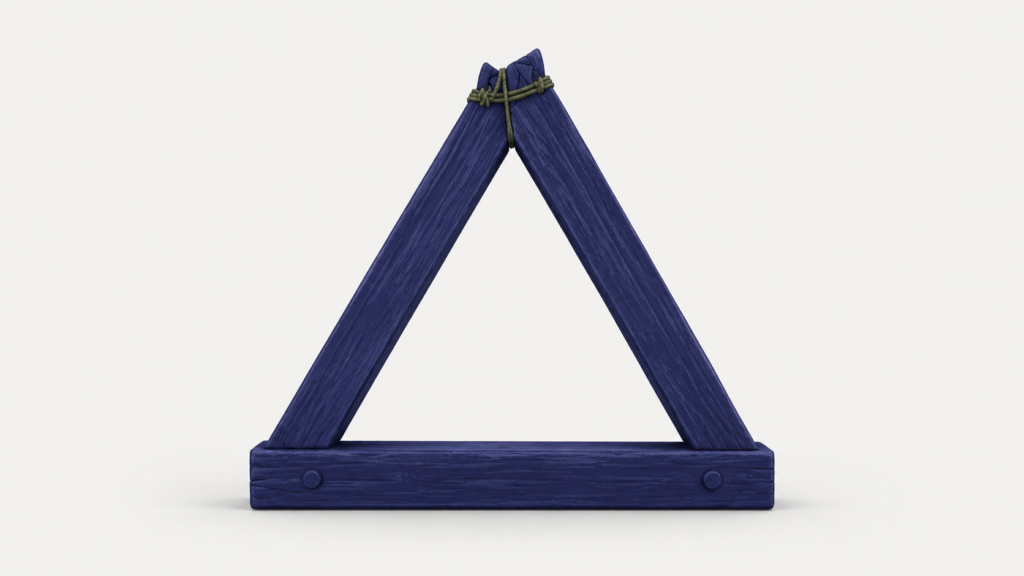
That triangle is where the book takes its name. A wagon, like a team, does not hold together because each part happens to be strong on its own. It holds together because each part leans on the other two and shares the load. That single image is the whole idea of the Tension Triangle: three things, each one necessary, each one depending on the other two to stay standing.
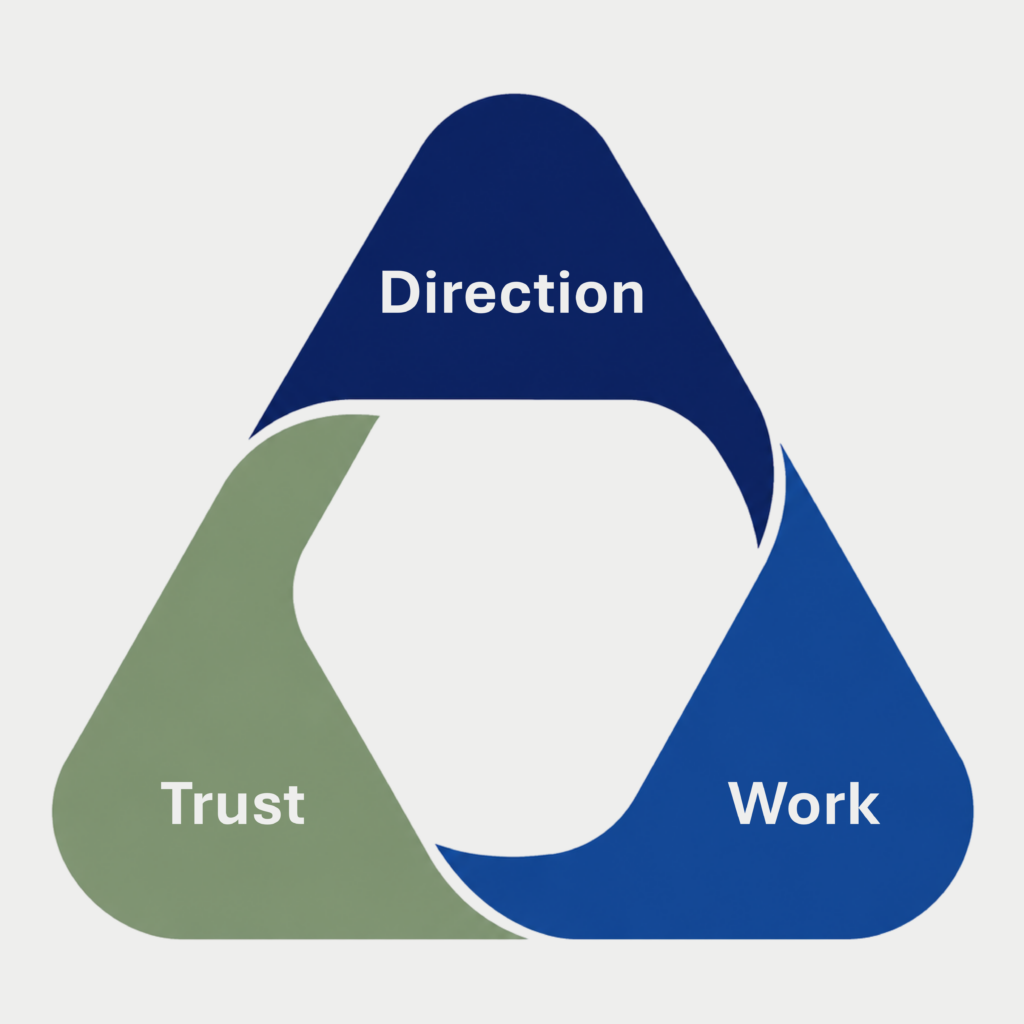
In the book, the three sides of the triangle are given names: Direction, Trust and Work. Each one sounds simple on its own. But each one carries a precise meaning that most teams have never quite found the words for.
Direction is whether people can use the stated plan to make their own decisions, without having to check with someone above them first. A team has a direction problem when two people, facing a similar situation, make opposite calls, and both of them can explain their reasoning perfectly clearly. That isn’t carelessness. It happens because the plan never reached far enough down to the place where the real decisions actually get made.
Trust is whether people feel safe enough to say what’s really happening, before it hardens into a bigger problem. A team has a trust problem when meetings end too smoothly. Agreement arrives too quickly and too easily. Nobody is lying, exactly, but honesty has quietly become something that costs too much to bother with. People learn, often without anyone meaning to teach them, exactly what is safe to raise and what is better left unsaid.
Work is whether the effort being put in is actually building something that will hold, rather than something that only looks like progress from a distance. A team has a work problem when everything seems fine in the update meeting. Then, weeks later, the same task has to be redone because something underneath it was never solid in the first place. The work looked finished. It simply hadn’t been tested yet.
None of these three forces stands apart from the other two. When direction is unclear, people quietly start making their own calls and stop mentioning it, because raising it openly would need a level of trust that isn’t really there. If trust is low, small cracks in the work go unreported until they grow too large to hide. And when the work itself starts to wobble, holding a clear direction becomes much harder, because the feedback that would correct the course never arrives in time to use it.
This is exactly why the Tension Triangle is shown as a shape instead of a list. A list suggests three separate items you could tick off one at a time. A triangle shows three things holding each other up, where a weakness in one will always show up, sooner or later, somewhere in the other two.
These three forces rarely announce themselves with a clear warning sign. They show up in small, ordinary moments that are easy to dismiss on their own.
A direction problem often looks like two competent managers giving different answers to the same kind of question, each one fully convinced they are right. A trust problem often looks like a meeting that ends a little too neatly, where the real disagreement happens afterwards, quietly, in the corridor. A work problem often looks like a project marked “on track” for weeks, followed by a sudden scramble once the gap underneath it is finally exposed.
None of these moments will set off an alarm by themselves. That’s exactly what makes the Tension Triangle useful. It gives ordinary, easy-to-miss moments a name. With that name, a leader can spot the pattern earlier. They don’t have to wait for three or four small moments to pile up into something much harder to untangle.
You don’t need to run a company to understand the Tension Triangle. Think of a school project where four students share the work. Or think of a sports team halfway through a season.
In the school project, direction breaks down when two students do their part well, but in completely different directions, because nobody agreed on what “done” actually looks like. Trust breaks down when one student notices the plan isn’t working, but says nothing, because the last time someone raised a problem, it was brushed aside. Work breaks down when each piece looks fine on its own, right up until the night before it’s due, when nothing quite fits together.
In the sports team, the same pattern shows up. Direction breaks down when players make different choices in the same kind of moment, because the game plan never quite reaches the field. Trust breaks down when a player stops mentioning that a tactic isn’t working, because raising it last time felt pointless. Work breaks down when training looks solid all week, then falls apart under real pressure on match day, because the conditions that would have tested it properly were never there in training.
The Tension Triangle isn’t really about wagons, bridges or boardrooms. Those are simply the clearest way to show a pattern that turns up almost anywhere people depend on each other to finish something together.
The book follows the story of James Calloway, a newly appointed CEO at a consulting firm called Halcyon Advisory. On paper, his firm looks steady. Revenue has held. Clients have stayed. People are still showing up and working hard.
But James can feel something underneath the numbers that the numbers themselves cannot show him. Decisions are taking longer than they should. Two of his best people are quietly being courted by competitors. Meetings are ending too cleanly, as if something important keeps being left unsaid.
He cannot yet name what is wrong, only that something is. That feeling, the book argues, is not weakness or paranoia. It’s an early, accurate signal that the Tension Triangle has already started to come apart, well before the results have caught up to confirm it. Learning to trust that early feeling, rather than waiting for a chart to prove it, is one of the central skills the book is trying to teach.
Here is the uncomfortable part. The Tension Triangle seldom breaks all at once. It drifts.
Drift is the word the book uses for this slow, quiet pulling apart. It doesn’t look like a crisis; it just seems that things are taking slightly longer than they used to. Sometimes it is a meeting that ends in easy agreement, when a harder conversation was actually what the moment needed. Or it may look like a project that stayed “on track” right up until the exact moment it clearly wasn’t.
The trouble with drift is that nobody can ever point to the single day it began. Each small sign, taken on its own, looks like nothing much. A slightly slower decision here. A slightly too smooth meeting there. A small piece of rework that nobody thinks twice about. Leaders, quite understandably, respond to whatever symptom happens to be in front of them. They push for more speed, or run a workshop about culture, or tighten the process with another layer of approval. Sometimes that helps for a little while. More often, it simply adds extra pressure to a system that was already straining underneath.
The Tension Triangle argues that results are always the very last thing to show a problem. By the time the numbers finally confirm that something is wrong, the drift has usually been running through decisions and conversations for months already. The people inside the team often sense it long before any report does. They feel the slight thickening in the air, the meetings that end a little too cleanly, the effort that keeps quietly rising without anyone being able to say exactly why.
If Direction, Trust and Work are the three sides of the triangle, then alignment is something different. It’s the thing that decides whether those sides are truly leaning on each other or simply sitting near one another without really connecting.
It’s worth being precise about what alignment actually means here, because the word gets used loosely almost everywhere else. Alignment is not the same thing as agreement. A team can agree on its goal and still be badly misaligned because each person is quietly carrying a different, unspoken assumption about what it will actually require to reach that goal.
Picture two engineers building a bridge from opposite banks of the same river. Both agree, fully and sincerely, on exactly where the bridge should meet in the middle. But if one of them assumes the bridge only needs to carry people on foot, and the other assumes it needs to carry heavy lorries, they are not really building one bridge together. They are building two separate halves that will never properly meet, no matter how much they agreed on the destination at the start.
That is the quiet danger the Tension Triangle keeps returning to. Shared goals can easily hide completely different assumptions about cost, time, sequence and risk. Those assumptions rarely get raised out loud, because questioning them can feel like doubting the goal itself. It isn’t. Examining those assumptions is the actual work that makes the goal possible in the first place.
The book is light on instructions and heavy on questions, which fits its whole way of thinking. Naming a problem, it argues, works far better as a question than as a flat statement. A statement tends to make people defensive. A genuine question tends to open the door instead.
The first question is about direction. Think of three decisions your team made recently, choosing the most contested ones rather than the easiest. For each one, ask whether someone closer to the actual work could have reached the same answer using the stated plan alone, without needing to check with anyone above them. If the honest answer is no for more than one of those three, the plan isn’t reaching the people who depend on it most.
The second question is about trust. Think back to the last time someone told you a hard truth about your team or your work. What did you actually do with it afterwards? Trust gets rebuilt by going back to that person and showing them, specifically, what changed because of what they said. Simply announcing that “honesty is welcome here” rarely shifts anything at all. People are watching what leaders actually do with the truth they’re given, far more closely than they listen to what leaders say about wanting it.
The third question is about work. Pick one piece of work that is currently in progress and ask the people doing it where they expect it to get hard later on. Listen closely for any answer that describes a conversation rather than a task. That conversation is usually where the real difficulty is quietly hiding, and it is far cheaper to have it now than to deal with whatever breaks later because nobody had it in time.
The deeper point running through the Tension Triangle is that the right response is rarely the biggest one available. A direction problem doesn’t need a brand-new strategy document. It needs translating into language that actually reaches the people making real decisions. A trust problem doesn’t need a workshop. It needs a leader who keeps showing, again and again, exactly what happens to the truth people hand over. A work problem doesn’t need a brand-new process. It needs someone willing to follow one piece of work down to the point where it actually gets difficult.
You might wonder why a leadership idea like this is told through wagon makers, bridge builders and a fictional firm called Halcyon Advisory, rather than through a straightforward checklist you could pin to a wall.
The book’s own answer is that a checklist can make perfect sense on the page and still completely fail to register in the middle of a real, messy meeting. A story works differently. Once a picture like the standing triangle, or the two bridge halves that never quite meet, settles into your memory, it tends to resurface exactly when you need it. Often, that happens weeks later, in a meeting that suddenly looks very familiar.
That is really what the Tension Triangle is offering. Not a new vocabulary to memorise and recite, but a small handful of images sharp enough to change what you actually notice the next time your own team begins to drift.
This isn’t really a book for a leader already deep inside a crisis. Crisis tends to bring its own urgency, its own consultants, its own adrenaline to push everyone forward.
The Tension Triangle is written for a quieter, harder moment. It’s for the season when results are still acceptable, the team is still intact, and everything on the surface looks manageable. Underneath that, though, the effort it takes to hold it all together keeps slowly rising. It’s also written for the leader who has already tried the obvious fixes. More accountability, more clarity, and more pace. And the leader has noticed that these fixes helped a little less than they cost.
If that sounds like a fairly specific kind of leader, it is. But it’s also a far more common situation than most people are willing to admit out loud in a meeting.
If any part of this has felt familiar while you were reading it, that feeling is worth paying attention to. It usually means you’ve already been sensing some version of this drift, somewhere just under the surface, without quite having the right words for it yet.
The Tension Triangle does not promise to fix your team in a single afternoon. What it offers instead is a way of seeing the early cracks while there is still time to do something precise about them, rather than something loud and rushed.
If that sounds useful, the full book is worth a slow read rather than a quick skim. Read it the way it was written, gently, with enough room to notice your own team quietly inside the stories.
The book will be available on Takealot, Amazon, Barnes & Noble, Baker & Taylor, and many eBook platforms.