

Once managers have strong foundations, communicate effectively and lead with confidence, the entire business begins to perform differently.
Management coaching does not simply improve individual managers. It improves the systems, behaviours and relationships that drive organisational success.
Here are five ways management coaching creates sustainable business growth.
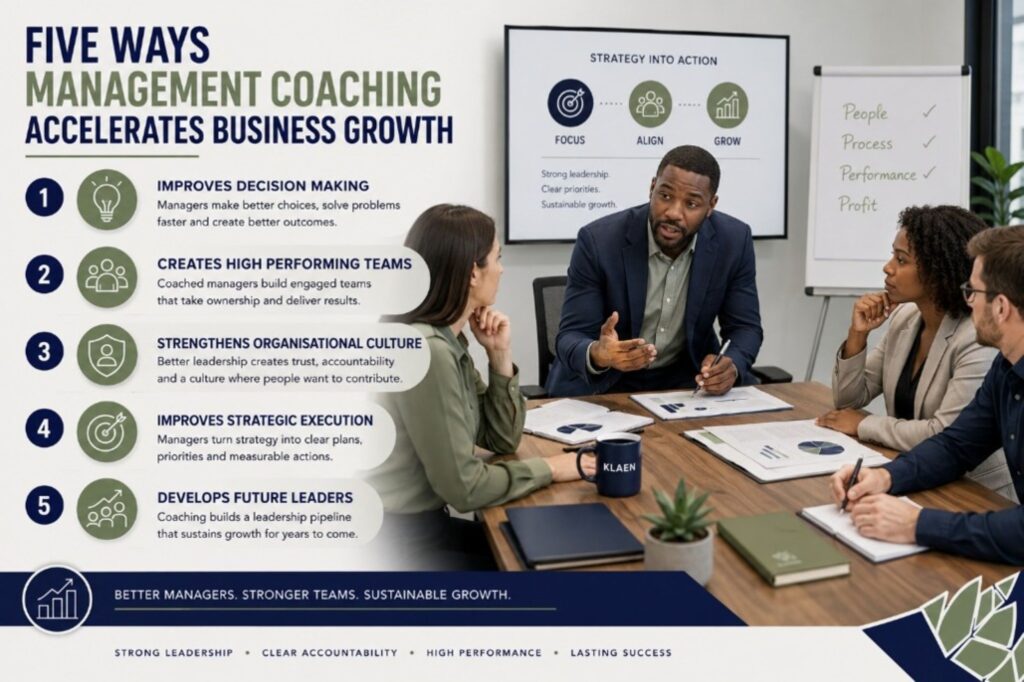
Managers make hundreds of decisions every week, ranging from small daily choices to decisions that affect employees, customers, and profitability. Poor decisions often occur when managers are under pressure, lack confidence, or do not have a structured way of thinking through problems.
Management coaching helps managers slow down, ask better questions, and evaluate their options before taking action. Instead of simply reacting to problems, they begin to respond more strategically. Over time, decision-making becomes more consistent across the organisation, employees gain confidence because expectations become more predictable, and customers experience better service because managers solve problems more effectively. Business owners also spend less time correcting avoidable mistakes. Good decisions build confidence, but consistently good decisions build successful businesses.
A manager’s success should not be measured only by personal performance. It should also be measured by the performance of the team they lead. Exceptional managers know how to bring out the best in others. They understand that every employee has different strengths, motivations and development needs.
Management coaching helps managers learn how to:
Teams led by coached managers usually become more engaged because people understand their purpose, receive regular feedback and know their contributions matter.
High-performing teams are rarely created by chance. They are developed through consistent leadership.
Culture is not created by motivational posters or company slogans; it is shaped by the daily behaviour of managers. Employees notice how managers respond when mistakes happen, whether promises are kept, and whether people are treated fairly. Every conversation, decision, and reaction either strengthens or weakens the organisation’s culture.
Management coaching helps managers build cultures based on:
Strong cultures encourage people to contribute ideas, solve problems and support one another. Weak cultures create fear, blame and unnecessary conflict. Business growth is far easier when people work together towards common goals.
Many organisations have excellent strategies, but far fewer execute them consistently. The challenge is rarely the strategy itself; it is turning plans into daily actions. Managers play a critical role in connecting strategy to execution by translating objectives into priorities, allocating resources, monitoring progress, and removing obstacles.
Management coaching equips managers with the skills to keep teams focused on what matters most. Instead of constantly reacting to urgent issues, they learn to prioritise activities that create long-term value. A strategy only creates results when managers bring it to life.
Every growing business needs a leadership pipeline because growth eventually slows when leadership depends on one owner or one executive. Management coaching prepares today’s managers to become tomorrow’s senior leaders, reducing organisational risk and creating continuity. Businesses that consistently develop leaders are generally more resilient during periods of growth, succession, and change. Leadership development is therefore not a once-off event, but an ongoing process.
One of the most common questions business owners ask is:
“How do we know whether management coaching is working?”
This is an important question because coaching should produce measurable improvements.
While every organisation is different, businesses often monitor indicators such as:
Research from organisations such as Gallup and the International Coaching Federation has consistently found that stronger leadership and coaching cultures are associated with higher engagement, improved organisational performance and better retention of talented employees.
Although coaching is an investment, its value is reflected in better business outcomes over time.
The opposite is often true. High-performing organisations coach their strongest managers because continuous improvement creates competitive advantage.
Experience is valuable, and learning is essential. The most successful leaders continue developing throughout their careers.
Meaningful behavioural change takes time. Managers improve through practice, feedback and reflection. The greatest benefits usually become more visible over several months as new habits become part of everyday leadership.
Training transfers knowledge, while coaching develops capability. The two work best when they are used together because training explains what managers need to do, and coaching helps them apply that knowledge consistently in real business situations.
Management coaching is a structured process that helps managers improve their leadership, communication, decision making and people management skills through practical guidance, feedback and accountability.
Who benefits from management coaching?
Business owners, executives, senior managers, department heads, supervisors and newly promoted managers can all benefit from management coaching.
The answer depends on the organisation’s goals. Many businesses begin seeing improvements within a few months, while lasting leadership development is achieved through ongoing coaching over a longer period.
Management coaching focuses primarily on helping managers lead teams and improve operational performance. Executive coaching focuses more broadly on strategic leadership, organisational direction and executive decision-making.
For many organisations, the answer is yes. Improved leadership, stronger employee engagement, better execution and higher productivity often produce returns that extend far beyond the cost of the coaching programme.

Every business reaches a point where growth becomes more difficult. Many owners assume they need more customers, while others believe they need better systems or more technology. Sometimes they do.
However, sustainable growth is usually achieved by strengthening the people responsible for leading the organisation. This is why Klaen Consultants developed the Management Ceiling concept. As businesses grow, complexity increases, and management capability must increase at the same pace. Management coaching raises that ceiling by helping leaders think differently, communicate more effectively, and build stronger teams. When managers improve, departments improve. When departments improve, customers notice. When customers notice, businesses grow.
Businesses do not become exceptional simply because they have great products or ambitious strategies. They become exceptional because capable leaders consistently help ordinary people achieve extraordinary results. Management coaching is therefore about far more than developing individual managers; it is about creating an organisation where communication is clear, accountability is embraced, leadership is trusted, and business growth becomes sustainable.
Every conversation a manager has shapes the future of the organisation, because every decision influences culture and every coaching moment creates another opportunity for improvement. Businesses that invest in management coaching are therefore investing in the people who will determine tomorrow’s success. The real question is not whether your business can grow, but whether your management capability will grow with it.
Take a moment to reflect on your management team.
Ask yourself:
Even one improvement in leadership can have a positive impact across an entire organisation. Developing capable managers today lays the foundation for stronger teams, better decisions and sustainable business growth tomorrow.