
Organisations often believe their biggest challenge is strategy. Leaders spend time planning the business’s future direction and defining priorities to guide decision-making. Yet many organisations discover that even a strong strategy does not always lead to improved performance.
The reason is simple. Strategy alone does not determine how an organisation performs. Performance depends on the alignment between strategy, culture and execution.
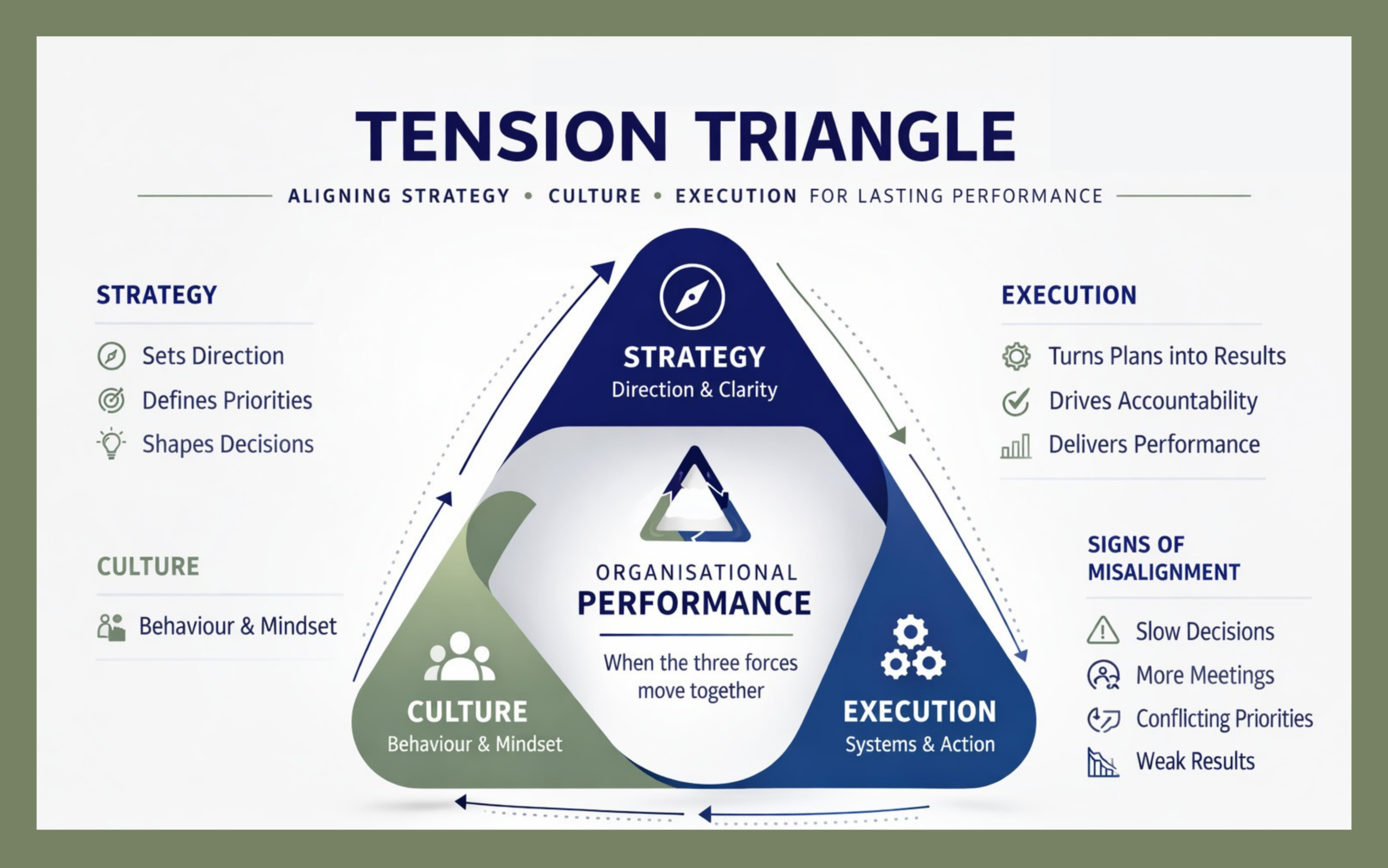
At Klaen Consultants, this relationship is described through the Klaen Tension Triangle. The triangle explains how these three pillars form the foundation of organisational performance.
When these three forces align, the organisation moves forward with clarity. When they drift apart, tension appears, and progress becomes slower.
Understanding strategy, culture, and execution alignment, therefore, helps leaders recognise why organisations sometimes struggle even when the strategy appears sound.
The alignment refers to the way the three organisational forces work together.
Strategy defines the direction of the organisation. It describes where the organisation intends to move and what priorities should guide decisions.
Culture reflects the behaviour of people within the organisation. It includes the habits, beliefs and expectations that shape how work is carried out.
Execution refers to the systems and processes that translate plans into action. These include meetings, reporting systems, accountability structures, and operational discipline.
When strategy culture execution alignment exists, these forces reinforce one another. Strategy provides direction. Culture supports the behaviours required for that direction. Execution systems convert effort into measurable results.
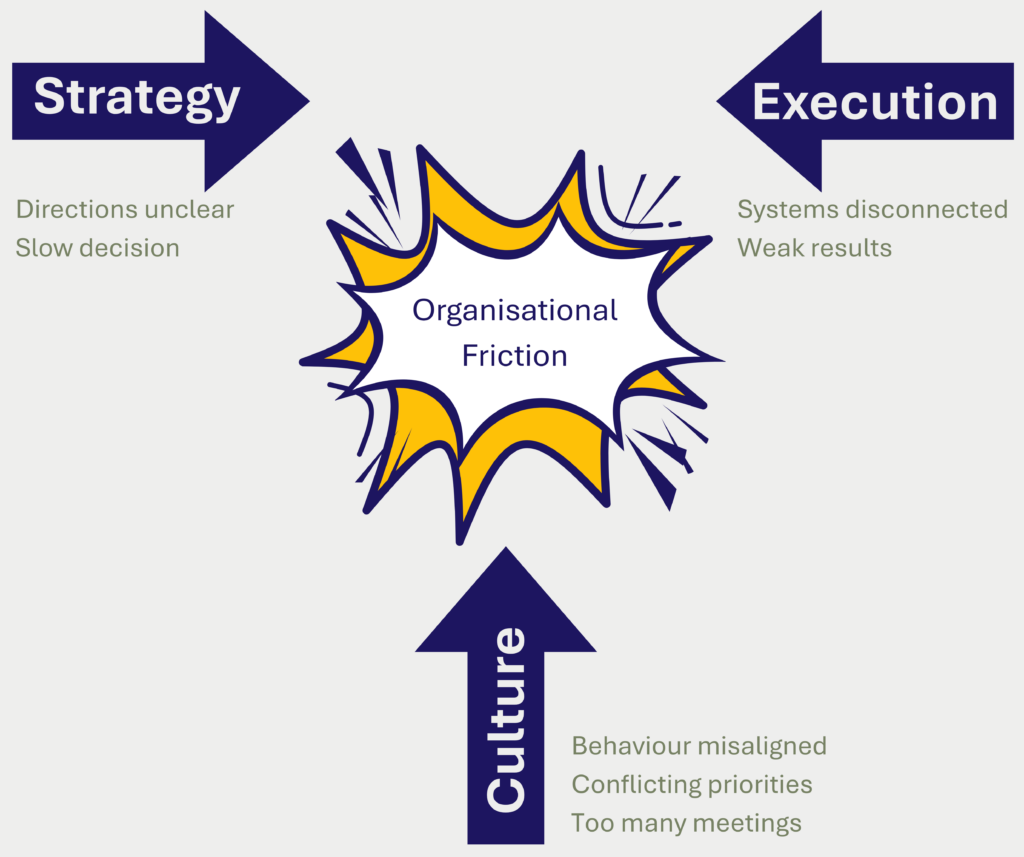
Without alignment, these forces begin to work against one another.
Organisations often experience problems that appear operational. Decision-making becomes slower. Meetings increase. Projects stall. Teams struggle to maintain momentum.
These challenges often appear as management issues or communication problems.
However, many of these symptoms arise because the alignment has weakened.
For example, a new strategy may be introduced that requires collaboration across departments. If the existing culture rewards individual performance rather than cooperation, the strategy will struggle to gain traction.
Similarly, execution systems may grow larger and more complex as the organisation expands. If those systems are not linked clearly to strategic priorities, they may create activity without improving results.
When alignment weakens, the organisation begins pulling in different directions. Effort increases, but performance improves slowly.
In many organisations, strategy, culture, and execution alignment break down because these elements are managed separately.
Strategy discussions take place during planning sessions or board meetings.
Culture often appears in values statements or human resource programmes.
Execution is addressed through operational reviews and performance management systems.
Because these conversations occur in different parts of the organisation, they rarely connect.
As a result, the strategy changes while behaviour remains the same. Culture programmes appear but do not influence operational performance. Execution systems grow more detailed but drift away from the strategic priorities they were meant to support.
Over time, the organisation works harder while results improve only slowly.
The difficulty does not come from a lack of effort. The difficulty comes from a lack of alignment.
Leadership teams play a central role in maintaining alignment.
Leaders define the strategic direction of the organisation. Their behaviour influences organisational culture. Their decisions shape the execution systems that guide daily work.
For this reason, leadership teams benefit from regularly examining how these forces interact.
Leaders should ask whether the strategy is clearly understood across the organisation. They should consider whether leadership behaviour reinforces the culture required for success. Additionally, they should review whether execution systems translate strategic priorities into practical action.
When these questions are addressed regularly, alignment becomes easier to maintain.
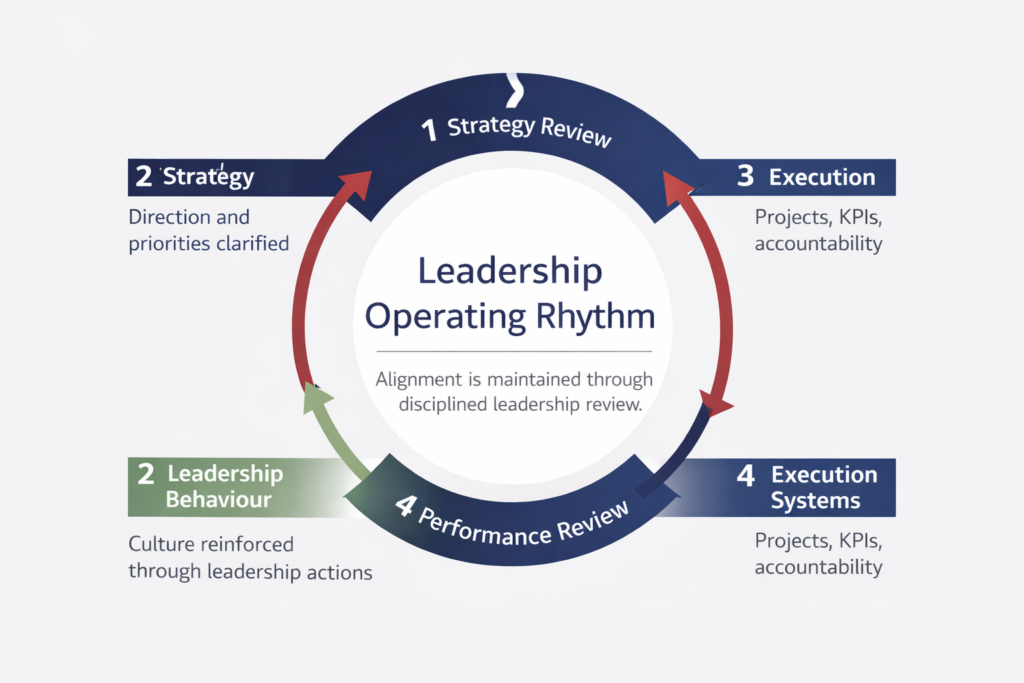
One important factor supporting this alignment is the presence of a clear leadership operating rhythm.
Operating rhythm refers to the structured way leaders review progress, discuss challenges, and reinforce priorities.
Without this rhythm, strategy remains conceptual. Culture remains aspirational. Execution becomes fragmented.
A disciplined operating rhythm reconnects these forces. It ensures that strategy remains visible, culture remains reinforced, and execution systems continue to support both.
Through regular leadership discussions, organisations can maintain alignment and adapt when conditions change.
The Klaen Tension Triangle can also be used as a diagnostic tool for organisations seeking to improve performance.
When execution becomes slow or difficult, the strategic direction may not be clear enough. And, when strategic initiatives fail to gain traction, the culture may still reward previous behaviour.
If culture programmes do not influence results, the execution systems may not reinforce them.
Examining the relationship between these forces helps leaders identify the real source of organisational friction.
Rather than adding more processes, leaders can restore alignment between the three pillars.
When strategy, culture, and execution are aligned, organisations often experience significant improvement.
Decision-making becomes clearer because priorities are understood.
Meetings become more productive because discussions focus on meaningful actions.
Teams understand how their work supports the broader direction of the organisation.
Execution becomes simpler and more consistent.
Alignment allows organisations to move forward with greater momentum.
Organisations rarely struggle because they lack ideas or talent. More often, they struggle because the strategy, culture, and execution alignment have weakened.
Strategy sets the direction. Culture supports the behaviours required to move in that direction. Execution converts those behaviours into measurable results.
When these forces move together, organisations become more stable and more capable of sustained progress.
Strategy – culture – execution alignment, therefore, remains one of the most important responsibilities of leadership.
When leaders maintain this balance, the organisation does not need to rely on pressure to perform. The system itself begins to generate momentum and results.
If you recognise these patterns in your organisation, it may be useful to step back and examine the alignment between strategy, culture, and execution.
At Klaen Consultants, we work with leadership teams to identify where organisations begin pulling in different directions and to restore the operating rhythm that supports performance.
If you would value an external perspective, we would welcome a short conversation.
Contact Klaen Consultants to arrange a 30-minute leadership diagnostic discussion.