

Most CEOs do not step into the role expecting to spend their days managing emotion.
They expect to think about direction, about choices, about what must progress, and what must stop.
Yet, over time, something subtle shifts.
Executive attention drifts away from strategy and execution toward mood, reaction, and interpersonal fallout.
What begins as responsible leadership slowly becomes an invisible drain. It is not dramatic or obvious. It is just heavier.
There is a cost within executive teams that rarely appears in any formal setting. It does not sit on dashboards. It is not debated in board packs, nor is it named out loud.
But it accumulates.
Time is spent recalibrating conversations. Energy is spent anticipating reactions.
Focus is spent on managing how things are experienced rather than what they require.
This means that meetings stretch and decisions take longer to settle. Accountability feels careful instead of clear. Nothing is overtly broken, but everything takes more effort.
At some point, executive leadership begins to include emotional supervision. Not because leaders lack empathy or the team is incapable. But because the system no longer carries the weight it should.
Therefore, executives step in as translators, buffers, and quiet referees between strong views and strong personalities.
In the moment, this feels stabilising. It feels like mature leadership. However, over time, it consumes leverage.
The organisation becomes more dependent on senior leaders being present, attentive, and emotionally available. This means that strategy slows and execution becomes inconsistent.
The system leans upward.
When this happens, personality is often blamed: someone is labelled difficult, someone else is described as defensive, and another is said to be hard to work with. These descriptions are not always wrong, but they are rarely complete.
Personality only becomes operationally expensive when the context around it is unclear. It happens when expectations shift or standards are uneven. You see it when authority is applied selectively.
In environments with strong cultural clarity, very different personalities coexist without constant mediation. In unclear ones, even experienced leaders generate friction.
The difference is not temperament. It is designed.
Culture is often treated as a soft layer: something supportive, atmospheric, or something to address after strategy is set.
But at the executive level, culture functions as an execution system.
It determines how decisions are made when pressure rises. It controls how disagreement is handled when the stakes are high. Culture clarifies how accountability is applied when priorities collide.
When this system is unclear, leaders compensate manually. They manage outcomes person by person, conversation by conversation, and reaction by reaction.
That approach does not scale.
Over time, the emotional load becomes normalised, and leaders begin to anticipate fallout. That is when language softens and decisions slow.
Questions of delivery are quietly replaced by questions of impact: not impact on results, but impact on people. Performance conversations lose edge, and strategic focus fragments.
The organisation stays busy, but momentum slows down.
This is often described as a need for more psychological safety. But safety does not come from cushioning discomfort. It comes from predictability. From knowing what good looks like, and how challenge works. It comes from knowing which behaviours are not negotiable, regardless of role or tenure.
When these signals are missing, anxiety increases. Then executives step in, and emotional temperature rises.
The very effort to protect the team begins to exhaust it.
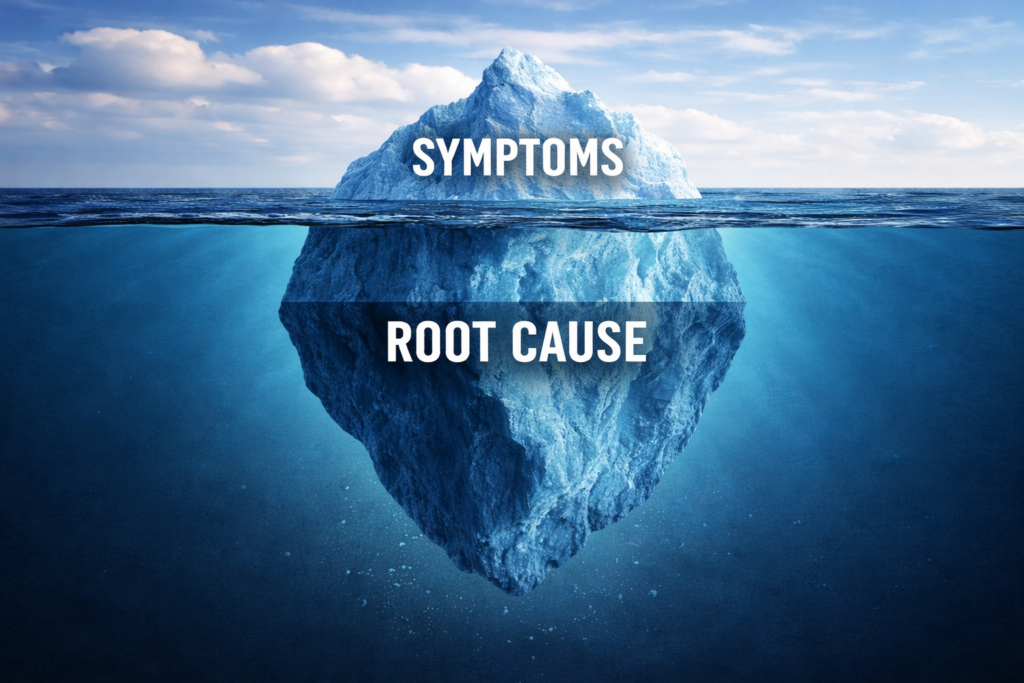
In organisations where this pattern has taken hold, leaders often treat symptoms.
Sometimes this helps for a while. But often, the strain returns in a different area because the system underneath remains unchanged. In the body, persistent symptoms point to an underlying condition. In organisations, the same is true.
Personality management treats what is visible. Cultural clarity stabilises what is structural. When the system settles, behaviour often follows.
CEOs frequently avoid cultural clarity, not because it is unimportant, but because it carries weight. It requires alignment at the top and consistency under pressure. It necessitates standards that hold even when it would be easier to bend them.
Managing emotion feels safer in the moment. It preserves surface harmony. It avoids immediate discomfort. But harmony without clarity does not hold. It just postpones friction.
Empathy remains essential. But empathy without structure quietly erodes organisations.
Support within clear expectations builds resilience. However, adjusted expectations to avoid discomfort build fragility. At scale, fragility becomes risk.
Strong cultures do not remove humanity. They remove ambiguity.
In clear cultures, feedback sounds different. It is factual. It is impersonal and grounded in shared standards. There is less heat.
Without clarity, the same feedback feels personal. It becomes defensive and threatening.
Emotion fills the gap that structure should have held, and executives step in again.
Most organisations carry at least one story about a “difficult” senior leader. Often, that same leader has thrived elsewhere. The shift is rarely about character. It is about context.
Unclear expectations amplify friction. Informal power dynamics distort behaviour. Change the system, and the label often dissolves.
Strategy rarely fails because it is poorly conceived; it fails because it does not move. Culture is the bridge that carries intent into daily decisions and actions. When that bridge is weak, leadership fragments. When it is strong, leadership scales.
Senior leadership is not controlling people. It is the act of designing conditions:
When those answers are embedded, leadership effort reduces. Energy moves back to its direction. Decisions land faster and momentum returns.

Clear cultures do not eliminate conflict; they make it productive. Ideas are challenged without identity being threatened. Decisions are tested without emotion escalating. Standards hold without constant explanation.
The organisation breathes more easily.
Quiet executive teams are not always healthy. Sometimes silence is avoidance. Sometimes it is fatigue.
Healthy systems have rhythm:
Personality management seeks calm, but cultural clarity enables flow.
Avoiding clarity always feels easier in the short term. But over time, it carries a cost: decision drag, leadership exhaustion, and weakened trust.
For CEOs, this is not a cultural conversation; it is a performance reality.
When executive teams spend more time managing tension than shaping direction, the signal is rarely about people. It is about the weight the system is asking leaders to carry. And the cost is already paid by the time this becomes visible.
Please share your ideas and experience in the comments below.