
There is a quiet moment every CEO eventually recognises.
A team waits, and a project stalls. A decision sits on your desk a little longer than it should. No one complains, yet momentum slows. The organisation begins to breathe through a narrower airway. Energy that once moved freely now feels congested. What was clear now feels slightly heavier.
Many CEOs describe this as pressure. Others call it responsibility. In truth, it is often an early signal of a deeper pattern, one that quietly pulls a business from flow into friction.
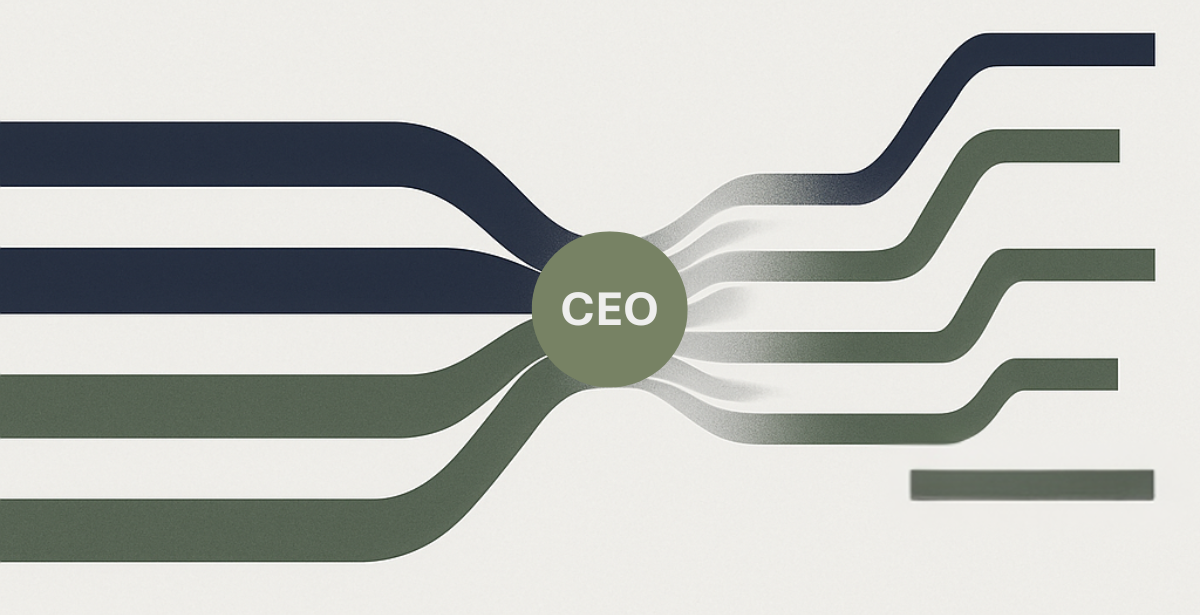
The CEO has become the bottleneck. Not by intention, but by accumulation.
This is the lived experience behind most CEO decision bottlenecks.
Decision bottlenecks rarely appear overnight. They form the way cholesterol builds in the bloodstream, grain by grain, until flow becomes restricted.
You see the signs:
• Teams escalate what they couldn’t resolve.
• Leaders wait for permission instead of acting.
• Issues loop back to you even after you thought they were solved.
• Everyone expects you to have the final word, the better word, or the safer word.
Look closely, and you will notice that the bottleneck is not caused by incompetence around you, but by a system shaped around you.
A system that has learned to depend on one mind for clarity.
This is the hidden architecture behind most decision bottlenecks. What looks like diligence is often organisational over-reliance.
Decision bottlenecks are not leadership failures. They are symptoms of misaligned culture and strategy.
A bottleneck forms when the leadership system relies on intention rather than structure. When clarity sits with one person rather than flowing across the organisation. When the team has rhythm but not autonomy, energy but not alignment.
CEO decision bottlenecks do not emerge because a leader is slow. They emerge because the organisation has not built an execution environment that distributes judgment, accountability, and trust.
In other words, culture has not kept pace with strategy, and the whole organisation becomes unsteady.

Imagine your organisation as a circulatory system. Strategy sets the direction, culture carries the oxygen, and execution provides the rhythm. When everything flows, decisions move quickly because the right people know the right things at the right time.
But if the arteries narrow, the muscles stop receiving what they need. Movement becomes heavy. Performance dips, not because the mind is weak but because the flow is compromised.
A CEO decision bottleneck is the organisational equivalent of restricted oxygen. The team is capable, yet the system does not empower them to breathe fully.
This is why CEOs feel exhausted while their teams feel cautious. One is over-functioning, the other under-functioning. Both are caught in a cycle that the system quietly reinforces.
After all, is a cautious team not safer? Yet caution without clarity breeds paralysis.
Several forces shape this pattern over time:
Once these forces combine, the organisation unconsciously trains itself to wait for you. Waiting becomes the dominant rhythm.
This is how decision bottlenecks become embedded in daily operations.
Bottlenecks appear harmless at first, like a minor delay in traffic. But over time, they become expensive.
Execution rate drops.
+ Innovation slows.
+ Leaders become reactive.
+ Meetings multiply.
+ Clarity dissolves into caution.
+ Execution becomes unpredictable.
A single decision sitting on your desk for five days can delay a team by two weeks. Multiply that across a quarter, and the cost becomes significant.
Execution drag costs more than most CEOs realise. Decision bottlenecks are often the root cause.
Once you see the pattern, the path to restoring flow becomes clear.
This is where alignment becomes oxygen again.
Once you address the cause, decisions begin to move again. The organisation regains rhythm. Energy returns. Flow replaces friction.

The purpose of this reflection is not to assign blame. It is to create awareness.
Decision bottlenecks are signals, not failures. They show that culture must grow to meet the demands of strategy. They remind you that leadership is not measured by how many decisions you make, but by the quality of decisions your team can make without you.
When strategy meets culture, execution flows. When execution flows, the organisation breathes again.
If you recognise some of this in your business, consider it an invitation. A gentle nudge from your own system telling you that clarity, alignment, and rhythm are ready to be strengthened.
Your next step is not to make more decisions. It is to redesign the environment so the right decisions happen without you. This is how you move from friction to flow, and from flow to predictable performance.
If you see the signs of a CEO decision bottleneck, this is your moment to shift from pressure to clarity.
At Klaen Consultants, we help CEOs and ExCo teams align strategy, culture, and execution so decisions move with rhythm rather than delay.
Book a Leadership Flow Diagnostic and let us help you restore the rhythm of your organisation.