
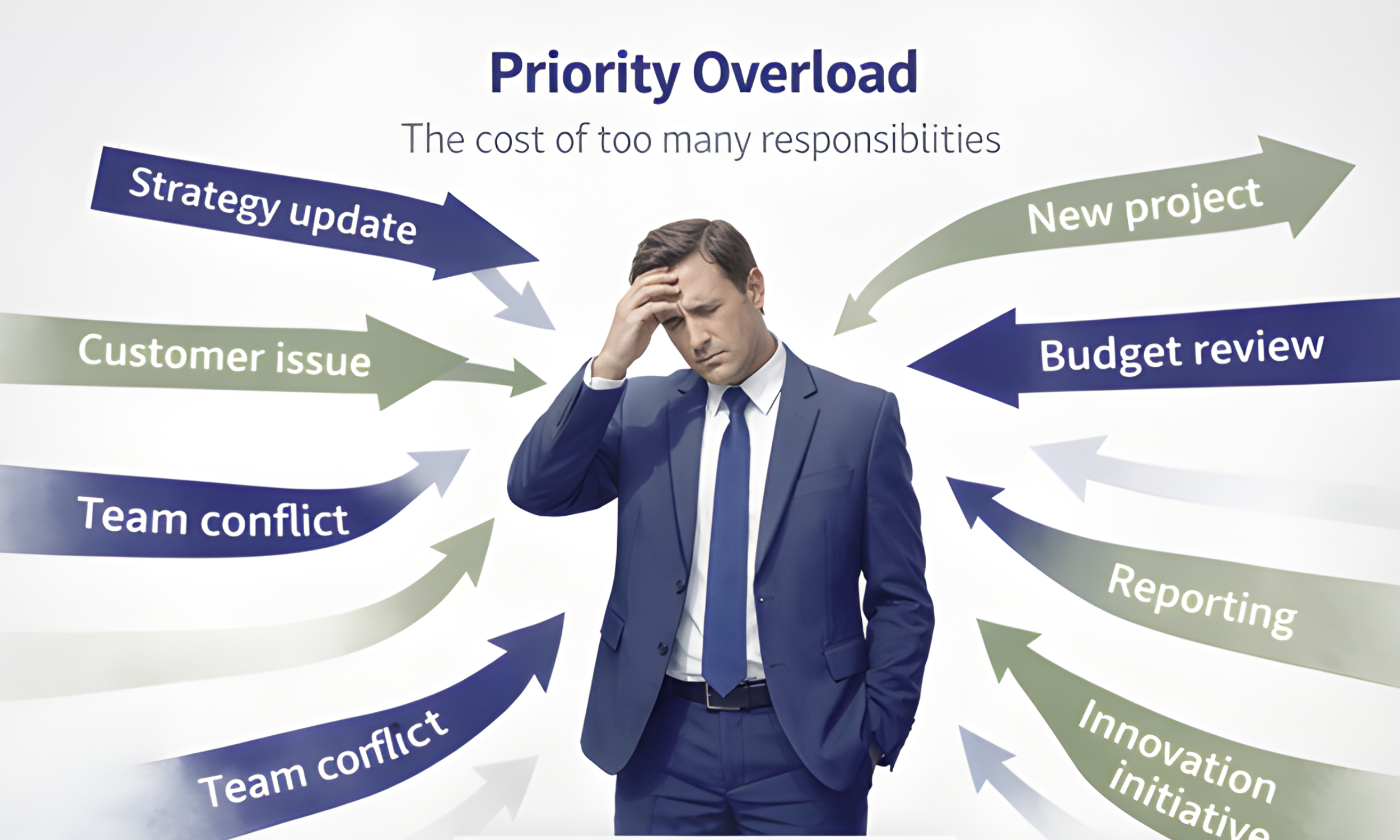
Modern organisations often believe that productivity comes from doing more. Leaders ask teams to take on more projects, more initiatives, and more responsibilities. At first, this approach seems sensible. More activity appears to mean more progress.
Yet many organisations quietly face a growing problem. Work increases while results improve only slightly. Meetings multiply. Deadlines slip. People feel busy all the time, but meaningful progress becomes harder to see.
This situation is known as priority overload.
Priority overload happens when individuals or teams are given more responsibilities than they can realistically manage. Instead of creating momentum, the organisation begins to lose focus. Energy spreads across too many tasks, and important work struggles to move forward.
Understanding the cost of priority overload helps leaders create healthier organisations where effort leads to clear results.
Priority overload occurs when too many responsibilities compete for attention at the same time.
Every organisation has many important tasks. Sales must grow. Customers must be served. New products must be developed. Systems must be improved. People must be trained.
Each of these activities may be valuable on its own. The difficulty appears when all of them are treated as urgent at the same time.
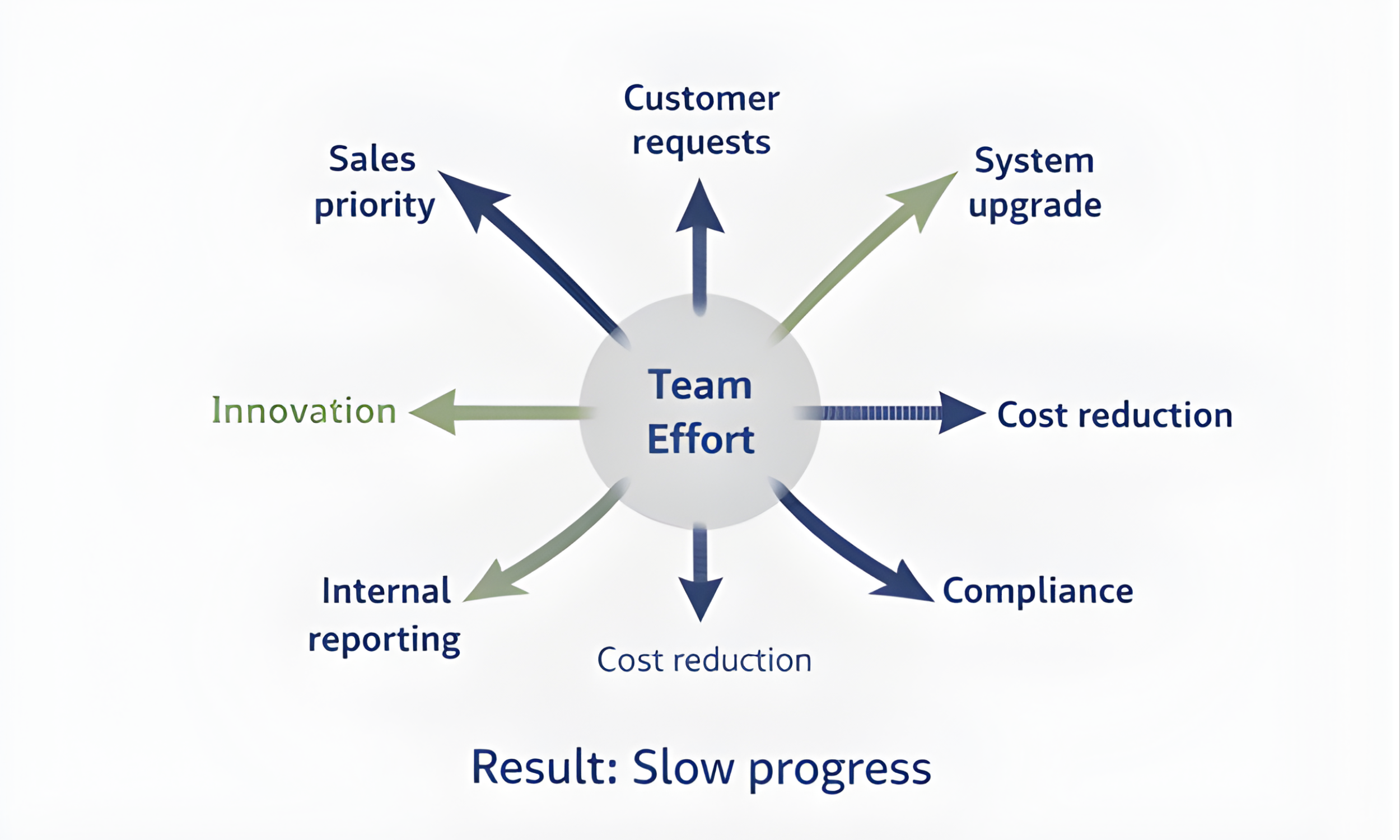
Human attention has limits. Teams cannot give full focus to twenty different priorities at once. When leaders attempt to manage too many responsibilities simultaneously, the organisation loses clarity.
Instead of moving confidently in one direction, the organisation begins to scatter its effort across many directions.
This scattering creates friction.
Teams struggle to understand which task truly matters most. Managers spend time explaining priorities again and again. Employees shift from one project to another without completing anything fully.
Priority overload, therefore, creates confusion long before it creates visible failure.
Priority overload rarely appears suddenly. It usually develops slowly as organisations grow.
A company may begin with a small number of clear priorities. As the organisation expands, new projects are added. New departments appear. New initiatives are launched.
Each initiative may seem reasonable on its own. Over time, however, the number of responsibilities grows beyond what the organisation can handle.
Several early signs often appear.
Decision-making becomes slower because leaders must consider many competing priorities.
Meetings increase because teams must constantly coordinate overlapping work.
Employees struggle to explain what the organisation is trying to achieve.
Projects remain half-finished while new projects begin.
These symptoms often appear before leaders recognise the underlying problem.
The organisation believes it needs more effort. In reality, it needs fewer priorities.
One of the main reasons priority overload creates difficulty lies in the limits of human attention.
People are capable of deep focus when they work on a small number of tasks. When attention is concentrated, progress becomes steady and predictable.
However, when people attempt to manage many responsibilities at once, their focus becomes divided.
Psychologists describe this challenge as task switching.
Each time a person moves from one task to another, the brain must adjust. This adjustment requires mental energy. When task switching happens repeatedly throughout the day, productivity drops.
Instead of making progress, people spend much of their time restarting their thinking.
Priority overload, therefore, reduces the quality of work even when employees remain highly committed.
The organisation may believe that people are not working hard enough. In reality, they are trying to manage too many responsibilities.
Leadership behaviour plays a major role in creating or preventing priority overload.
Leaders often face pressure from many directions. Customers demand improvements. Markets shift. Competitors introduce new products. Investors request faster growth.
In response, leaders may introduce new initiatives designed to address each challenge.
The intention is positive. Leaders want to strengthen the organisation.
Yet when new initiatives appear faster than old ones are completed, priority overload emerges.
Employees begin to hear many different messages about what matters most.
A team may receive instructions to improve customer service, reduce costs, develop new products, improve internal systems, and expand into new markets, all within the same quarter.
Each objective may be valuable. Yet when everything becomes urgent, clarity disappears.
Effective leadership, therefore, requires the discipline to choose a small number of priorities and protect them.
Priority overload creates high operational costs.
When teams attempt to manage too many responsibilities, work becomes fragmented. Projects move forward slowly because resources are constantly being redirected.
Important initiatives may remain unfinished for months.
Managers spend increasing time coordinating tasks rather than completing them.
The organisation may also experience growing operational complexity. New reporting systems appear. Additional meetings are scheduled to track progress across many projects.
These structures are often introduced to create control. Ironically, they add further pressure to already overloaded teams.
Over time, operational efficiency declines even though the organisation appears extremely busy.
Priority overload also influences organisational culture.
Culture reflects how people behave within the organisation. When priorities are clear, teams feel confident about their work. People understand how their efforts contribute to larger goals.
Priority overload weakens this clarity.
Employees begin to experience uncertainty. They may feel that expectations change frequently. Success becomes difficult to define.
In such environments, people often respond in two ways.
Some attempt to work longer hours to meet every responsibility. Others quietly focus on only a few tasks while ignoring others.
Both responses create tension within teams.
Employees may feel exhausted yet believe they are falling behind. Managers may feel frustrated because progress appears slower than expected.
Over time, morale can decline even though the organisation still contains talented people.
Decision-making becomes particularly difficult when priority overload exists.
Leaders must evaluate many competing initiatives. Each department may believe its work is critical.
Without clear priorities, leaders may attempt to support every initiative equally.
This approach spreads resources too thinly.
Instead of investing strongly in a few strategic areas, the organisation distributes attention across many small projects.
Decision speed slows because leaders must constantly reconsider trade-offs.
Important opportunities may be missed simply because the organisation cannot focus its energy quickly enough.
Priority overload, therefore, affects not only daily work but also strategic progress.
Despite its clear disadvantages, priority overload remains common in many organisations.
One reason is optimism. Leaders often believe that their teams can handle more work than is realistically possible. Enthusiasm for new opportunities can lead to ambitious plans that exceed available capacity.
Another reason is fear of missing opportunities. Organisations worry that if they reduce priorities, they may fall behind competitors. As a result, they attempt to pursue many opportunities at once.
A third reason involves communication. When departments operate independently, each team may introduce new initiatives without considering the organisation’s overall workload.
Without shared visibility of priorities, overload gradually develops.
Recognising these patterns allows leadership teams to respond more effectively.
Reducing priority overload begins with focus.
Leaders must ask a simple question.
What truly matters most right now?
Answering this question requires careful judgment. Not every initiative can receive equal attention.
Successful organisations often select a small number of priorities for a defined period of time. These priorities guide decision-making and resource allocation.
When new initiatives appear, leaders evaluate them against the existing priorities.
If a new initiative becomes essential, another responsibility may need to be postponed.
This discipline protects the organisation from constant overload.
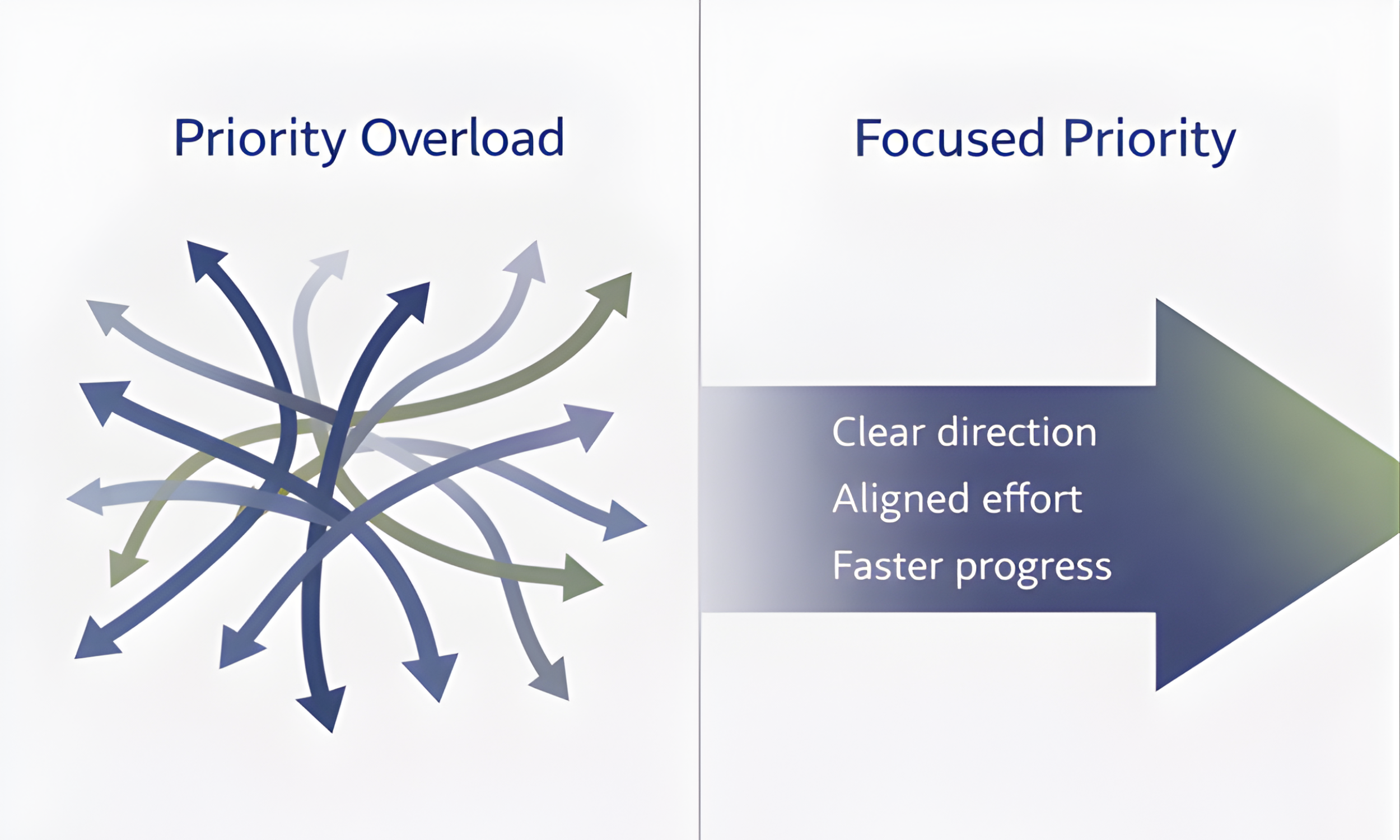
Focus creates clarity. Clarity allows teams to work with greater confidence.
Another important step in reducing priority overload involves clarifying responsibilities.
Employees must understand which tasks belong to them and which tasks belong to others.
When responsibilities are unclear, teams may duplicate effort or wait for decisions from multiple managers.
Clear responsibility structures simplify work.
Each person understands where their effort should be directed. Managers can evaluate progress more easily because expectations are visible.
Clarity does not eliminate work. It simply ensures that effort flows in the right direction.
When responsibility becomes clear, priority overload begins to ease.
Organisations can also prevent priority overload by establishing a clear leadership rhythm.
Leadership rhythm refers to the regular pattern through which leaders review priorities and progress.
For example, leadership teams may meet weekly to review operational results. Monthly discussions may examine strategic initiatives. Quarterly reviews may evaluate broader direction.
These structured discussions ensure that priorities remain visible.
Leaders can identify when new initiatives begin to compete with existing responsibilities. Adjustments can then be made before overload develops.
Leadership rhythm, therefore, acts as a stabilising force within the organisation.
It reconnects strategy, culture, and execution through regular dialogue.
When organisations reduce priority overload, several improvements often appear.
Teams experience greater clarity about what matters most.
Projects move forward faster because attention is concentrated.
Meetings become shorter and more purposeful.
Employees experience less stress because expectations become realistic.
Most importantly, results become easier to measure.
When priorities are clear, progress becomes visible. The organisation begins to move forward with steady momentum.
Reducing priority overload therefore benefits both performance and employee wellbeing.
Leadership ultimately determines whether priority overload grows or disappears.
Effective leaders recognise that every new initiative carries a hidden cost. Time, attention, and energy must be invested.
Before adding responsibilities, leaders must consider whether the organisation has sufficient capacity.
Sometimes, the most powerful leadership decision is not adding another project.
Sometimes the most powerful decision is choosing what not to pursue.
This discipline protects the organisation from unnecessary complexity.
By maintaining focus, leaders allow the organisation to move forward with confidence.
Priority overload is one of the most common yet least recognised challenges in modern organisations.
Leaders often assume that performance problems arise from a lack of effort or skill. In many cases, the true difficulty lies in excessive responsibility.
When too many priorities compete for attention, clarity disappears. Teams work harder while progress slows.
Understanding the cost of priority overload allows leaders to take a different approach.
By focusing on a small number of meaningful priorities, organisations create space for deep work, clear decision-making, and sustainable progress.
Reducing priority overload does not mean lowering ambition.
It means directing ambition toward the areas that matter most.
When attention, culture, and execution align around clear priorities, organisations begin to move forward with far greater momentum.
If these patterns sound familiar in your organisation, it may be helpful to pause and examine how priorities are currently managed.
Leadership teams sometimes benefit from stepping back and asking a simple question.
Are we trying to do too much at once?
Conversations that restore clarity often reveal simple adjustments that can release significant momentum.