
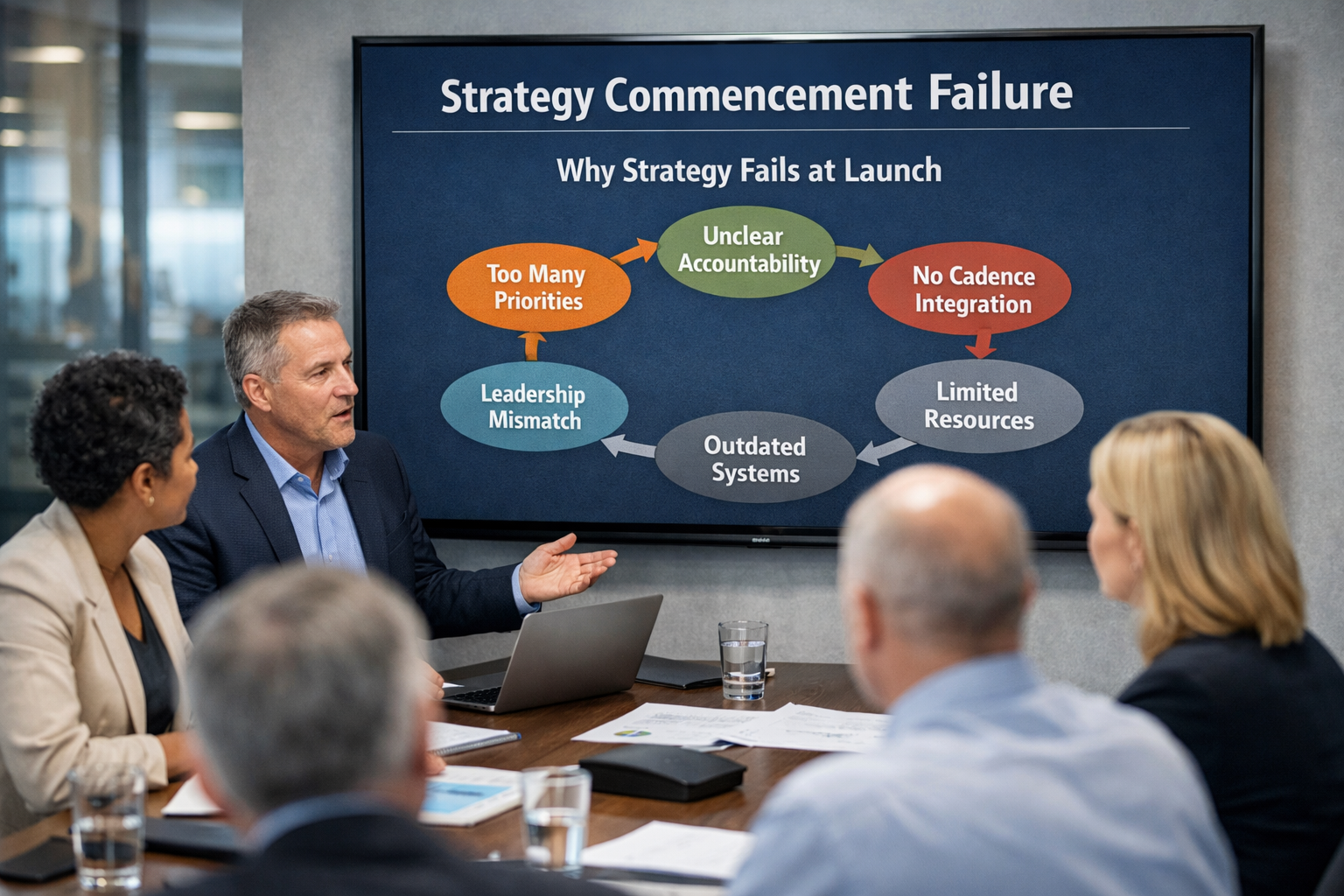
Strategy rarely fails in formulation. It fails in commencement.
In boardrooms across South Africa, strategies are debated, refined, stress-tested, and ultimately approved with conviction. There is alignment, optimism, and clarity of intent.
Yet within weeks of launch, something begins to erode.
The executive agenda reverts to familiar metrics. Legacy priorities resurface. Executives reference new strategic KPIs selectively rather than systematically. Resource tensions emerge. Accountability blurs at the edges.
Nothing dramatic has occurred.
And yet the strategy is already weakening.
This is Strategy Commencement Failure.
It is the structural breakdown that occurs when strategy transitions from intention to execution without sufficient architectural redesign. This is not a failure of intelligence or effort, iIt is a failure of readiness.
Planning occurs in controlled conditions.
Execution unfolds in operational complexity.
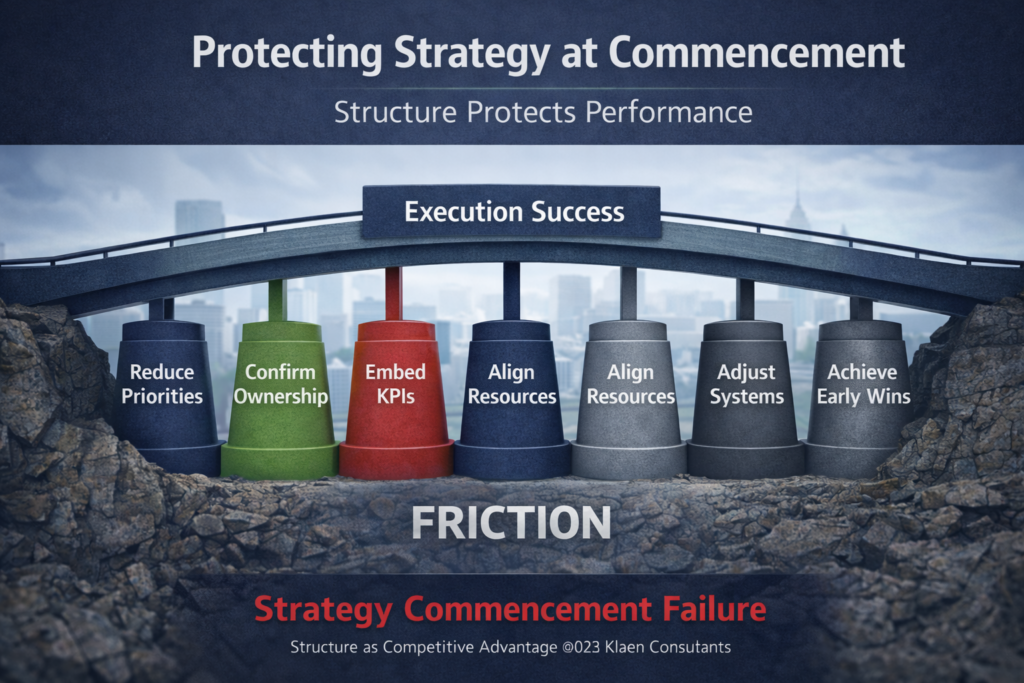
During planning, assumptions are aligned in principle. During execution, systems test those assumptions in reality.
The first 30 to 60 days after approval represent the highest-risk period in the strategy lifecycle. This is where seriousness is measured. Where governance either reinforces intent or dilutes it.
Strategy Commencement Failure emerges when leadership treats launch as communication rather than construction.
Approval is not activation.
Activation requires structural alignment.
While each organisation presents unique dynamics, the patterns are consistent.
Ambition is rarely the problem. Compression is.
When too many priorities transition into implementation unchanged, organisational bandwidth fragments. Leaders chase parallel initiatives. Energy disperses.
Execution demands focus.
High-performing executive teams narrow their strategy to a small number of measurable imperatives before launch. Without this discipline, activity increases while impact declines.
Planning sessions create perceived alignment. Commencement exposes ambiguity.
Ownership of KPIs, authority over resources, and escalation pathways should be explicitly documented. If not, momentum slows immediately. Decisions stall, and responsibility diffuses.
Execution begins where decision rights are clear.
Ambiguity is the oxygen deprivation of performance.
Strategy must enter the rhythm of executive review from week one.
If weekly governance forums do not embed the new strategic KPIs immediately, operational noise regains control. Old dashboards dominate the discussion. Legacy measures shape behaviour.
Strategy becomes narrative rather than a management system.
Cadence is not administrative. It is cultural reinforcement.
Budget allocations agreed in principle often encounter friction in practice.
Confirm funding, staffing, and system capacity operationally confirmed before commencement, or implementation delays are inevitable. Trade-offs create tension. Priorities compete for limited capacity.
Intent without resource alignment cannot generate traction.
Many organisations launch new strategies while retaining old performance infrastructure.
Reporting structures remain static. Incentive frameworks reward historical outcomes. Governance workflows reflect yesterday’s priorities.
Old systems sustain old culture.
A new strategy cannot survive within an outdated measurement architecture.
At launch, leadership attention sets direction.
If executives continue prioritising legacy issues, avoiding confronting underperformance, or delaying difficult decisions, the organisation interprets the signal quickly.
Strategy becomes optional.
Behaviour communicates seriousness more powerfully than messaging.
Momentum requires visible evidence.
Within 60 days, measurable progress must be demonstrated. Early wins strengthen credibility. They restore confidence across layers of the organisation.
Where commencement is followed by silence, belief erodes.
Strategy shifts from system to slogan.
Boards and Councils should treat Strategy Commencement Failure as a governance risk.
Within the first month of launch, five questions warrant formal oversight:
When these answers lack clarity, it exposes the organisation.
Strategy oversight does not end at approval. It begins there.
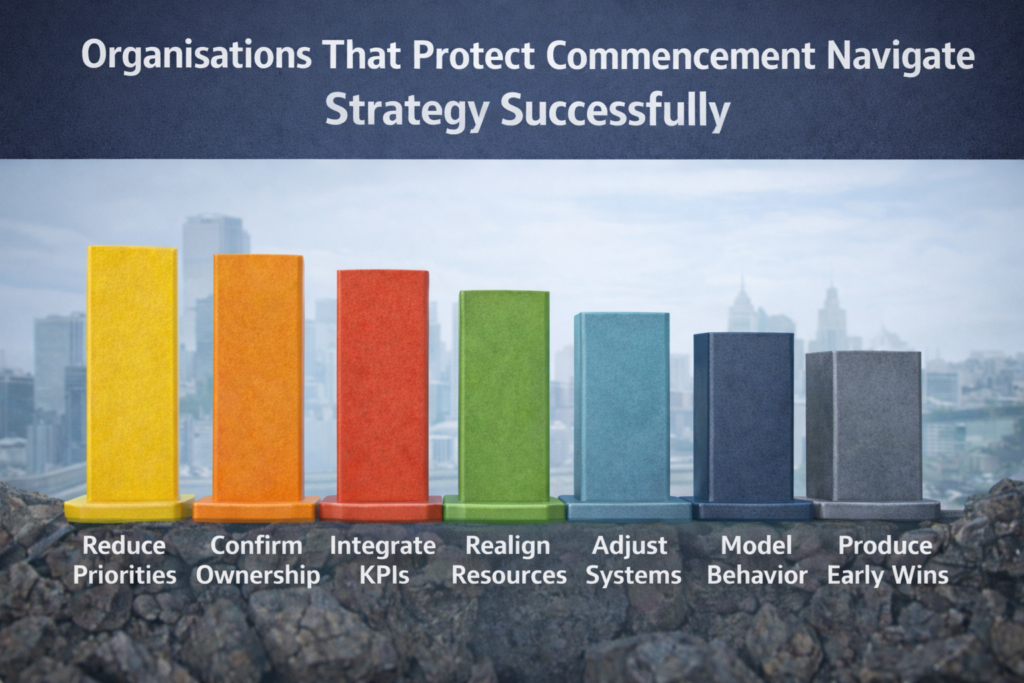
Preventing Strategy Commencement Failure requires deliberate architectural design.
It requires:
These are not dramatic interventions.
They are structural disciplines.
Organisations that treat commencement as a design phase rather than a communication phase outperform those that rely on momentum alone.
Before your next strategic cycle, ask:
Are we assuming readiness, or have we engineered it?
Approval does not validate strategy, but structural coherence in the first 30 days does.
Execution drag rarely begins with resistance.
It begins with ambiguity.
And ambiguity compounds quietly.
Strategy is approved in meetings. It is proven in structure.
The organisations that outperform others are not those with the most ambitious plans. They are those who protect the moment of commencement with disciplined architecture.
Where structure is clear, momentum stabilises. Where momentum stabilises, performance becomes predictable.
Strategy does not fail because it is flawed.
It fails because commencement was treated as an announcement, instead of a construction.
And in leadership, construction determines results.
Before your next strategy cycle, pause and ask your executive team one disciplined question:
That conversation alone can prevent Strategy Commencement Failure, because clarity at launch determines performance at year-end.