

Culture is often described as “how we do things around here”. But a more accurate description is this: culture is how decisions are made around here.
Every day, people decide:
These decisions reveal the true culture, not the posters on the wall.
Decision rights determine who gets to make these decisions, within what boundaries, and with what expectations. When they are clear, the organisation behaves with confidence. When they are unclear, behaviour becomes inconsistent, political, and slow.
This is why decision rights are not an administrative tool. They are a core culture system that directly shapes behaviour, trust, speed, and ownership across the entire organisation.
This blog explores how decision rights influence culture, why they are essential to strategic execution, and what leaders must do to design and implement decision rights that drive a high-performance environment.
It defines:
Almost every organisation has assumptions about these things. But assumptions lead to:
Decision rights bring structure to what is often emotional and political. They replace guesswork with clarity.
Examples of decision-rights issues in normal organisations
None of these are performance problems. They are decision-rights problems.
People behave according to the authority they believe they have.
If authority is unclear, behaviour becomes cautious and inconsistent.
If authority is clear, behaviour becomes confident and consistent.
When team members know exactly what they own, behaviour shifts towards:
This is how decision rights quietly shape culture.
People trust leaders who set clear boundaries. They trust teammates when roles are unambiguous. They trust the system when decisions follow a consistent pattern.
Unclear decision rights damage trust because people second-guess each other’s motives and actions.
Clear decision rights say:
We know who owns what. We know how decisions are made. We trust people to act within their authority.
This strengthens psychological safety, the foundation of a healthy culture.
Slow organisations are rarely slow because of laziness. They are slow because:
Clear decision rights create a culture where:
Speed is not a personality trait. It is a system.
Without decision rights, accountability becomes blurred. People make decisions without ownership, or they own work without the authority to decide.
Clear decision rights place accountability exactly where it belongs.
This produces a fair culture, not a blaming culture.
Unclear authority creates shadow power structures driven by:
This erodes culture. People learn to navigate personalities instead of processes.
Decision rights shrink shadow power and strengthen transparent authority. That builds a culture based on performance, not politics.
Weak decision rights do not just cause frustration; they also undermine trust. They create structural damage to culture and performance.
Tasks take longer, projects drift, and simple decisions require meetings or email chains.
Departments make isolated decisions that clash with each other. Rework becomes common.
Teams escalate everything, and leaders spend their days firefighting instead of thinking.
People stop taking initiative because decisions are overturned or questioned.
If authority is unclear, strategic goals cannot be executed consistently.
This is how culture decays quietly over time.
The most effective organisations treat decision rights as a structured, living system. Below is a complete framework you can apply in any environment.
Level 1: Autonomous Decisions
The individual has full authority. No approval needed. Consultation optional.
Examples:
Cultural impact: confidence, ownership, and self-leadership.
Level 2: Consulted Decisions
One person decides, but must consult others before acting.
Examples:
Cultural impact: collaboration without slowing execution.
Level 3: Joint Decisions
Two or more roles must agree.
Examples:
Cultural impact: unity and shared accountability.
Level 4: Escalated Decisions
High-risk or high-impact decisions require higher approval.
Examples:
Cultural impact: controlled risk and strong governance.
Create a simple decision-rights matrix that includes:
This matrix becomes the organisation’s behavioural guidebook.
A common mistake is making the system too complex. People should understand the rules easily.
The goal is to enable action, not create bureaucracy.
Escalation rules protect both authority and risk.
Define:
Escalation is part of culture. Clear rules stop unnecessary escalation and prevent dangerous delays.
Decision rights work only when they are widely understood.
Use:
Culture changes through repeated conversations, not one presentation.
Include decision behaviour as a measurable part of performance. Assess:
This ensures decision rights live inside behaviours, not documents.
As organisations grow, change strategy, or add new roles, decision rights must evolve.
Quarterly or biannual reviews keep the culture aligned with reality.
A regional logistics company struggled with inconsistent customer responses, supervisors escalating every issue, increased delays, and growing employee frustration and departmental tensions.
Leaders believed the problem was capability. But the real issue was unclear decision rights. Managers did not know which decisions they were allowed to make and escalated even minor issues to an already swamped CEO.
After a structured redesign:
Within six months:
The business culture improved because clarity improved.
6.1 Consistently ask: “Who owns this decision?”
This shifts conversations from excuses to ownership.
6.2 Protect people’s authority
Nothing destroys confidence faster than a leader who routinely overrides decisions.
6.3 Praise quality decision-making
Recognise people who show good judgement, even when decisions feel risky.
6.5 Coach poor decisions without removing authority
Correction without disempowerment builds maturity.
6.6 Model clarity yourself
Leaders who avoid decisions create a culture of avoidance. Leaders who confidently make decisions create a culture of confidence.
7.1. Higher Ownership Levels
People know exactly what they are responsible for.
7.2. Better Cross-Functional Collaboration
Consultation becomes a habit, not a negotiation.
7.3. Faster, More Confident Execution
Teams move without unnecessary approval loops.
7.4. Stronger Accountability
Clarity sets fair expectations.
7.5. Less Conflict
Most conflict happens because authority is unclear.
7.6. More Strategic Focus from Leaders
Leaders stop firefighting and start shaping the future.
7.7. How Decision Rights Shape Different Types of Culture
Decision rights are levers. Pull the right ones and cultural behaviour shifts reliably.
8.1. Over-engineering the system
Keep it simple and operational.
8.2. Focusing only on senior decisions
Middle and front-line decision rights matter more.
8.3. Ignoring informal networks
If influence is stronger than authority, culture becomes political.
8.4. Failing to train supervisors
They are the daily enforcement mechanism.
8.5. Changing roles without updating decision rights
This causes drift and confusion.
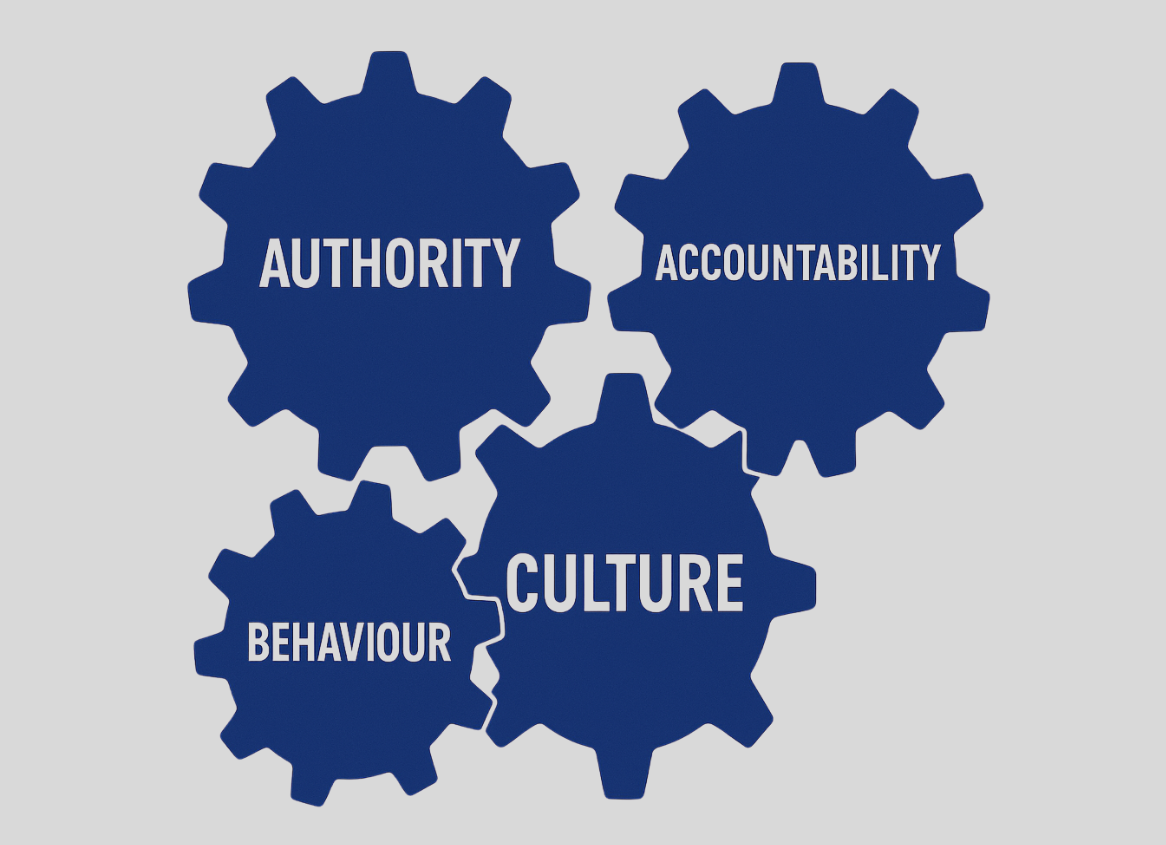
Every decision is a cultural signal. Every action reflects an assumption about authority, trust, and accountability. That is why decision rights are one of the most powerful and most ignored levers for building a strong culture.
Organisations that master decision rights become faster, more aligned, and far more resilient. They stop managing personality clashes and start managing clarity.
Design them well, and culture will follow
Are you ready to build a culture where decisions move with clarity, speed, and confidence?
Book a Diagnostic with Klaen Consultants.
Stop managing noise. Start leading with clarity.