

Most CEOs do not fail because they lack vision. They fail because the business cannot hold focus under pressure. The strategy is approved, the message is shared, and then Monday arrives with customer demands, operational shocks, cash pressure, and endless “urgent” escalations.
In South Africa, that pressure is measurable. The CSIR estimated the economy lost up to ~R2.899 trillion in 2023 (upper-limit estimate) due to rotational load shedding, and that the cost fell to about R481 billion in 2024 as performance improved.
This article explains why strategy often fails in mid-sized firms and gives a practical business strategy execution framework built for South African realities.
Board approval can feel like completion. It is not. It is the moment intent becomes public.
Strategy fails after approval because the business does not translate direction into daily behaviour: what people do, decide, measure, and stop doing. The organisation keeps running on old habits, while leadership expects new outcomes.
The typical failure pattern looks like this:
Be aware that none of this is about effort. It is about system design.
Strategy is a set of choices. Behaviour is what happens when stress arrives.
If your strategy does not change:
…then the strategy is still only a document.
Mid-sized firms often execute inside constraints that demand discipline:
+ Economic volatility from infrastructure risk: load shedding costs and operational disruption force teams into firefighting unless you build rhythm and redundancy.
+ Credit conditions shape execution capacity: SARB reporting shows credit extension growth accelerated in 2025—for example, from 3.9% y/y (Feb 2025) to 7.2% y/y (Oct 2025)—with household credit subdued. This matters because funding conditions and risk appetite directly affect project pacing and investment choices.
+ Employment structure is mixed: Stats SA data shows meaningful movement across formal and informal segments, which affects talent pipelines, supplier ecosystems, and operational consistency.
+ SME finance gap remains large: IFC estimates a formal MSME credit gap of about $30 billion, plus additional potential demand in the informal segment—meaning many businesses must execute with tight cash and limited buffers.
Remember: constraints do not remove strategy. They demand cleaner execution.
“Execution drag” is the slow friction that makes progress feel heavy:
Decision rights are often the hidden problem in mid-sized firms. As the company grows, the old “CEO decides everything” model breaks down, but a new decision-making system is not implemented.
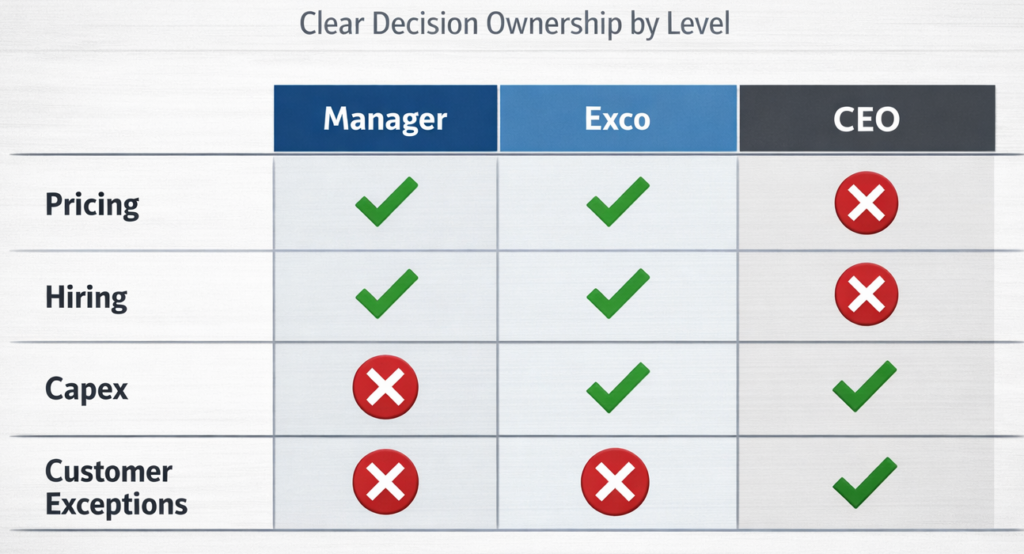
A useful rule: If the CEO is deciding what capable leaders could decide, the system is under-designed.
Governance is not paperwork. Done well, it protects focus and speed.
Mid-sized firms often swing between:
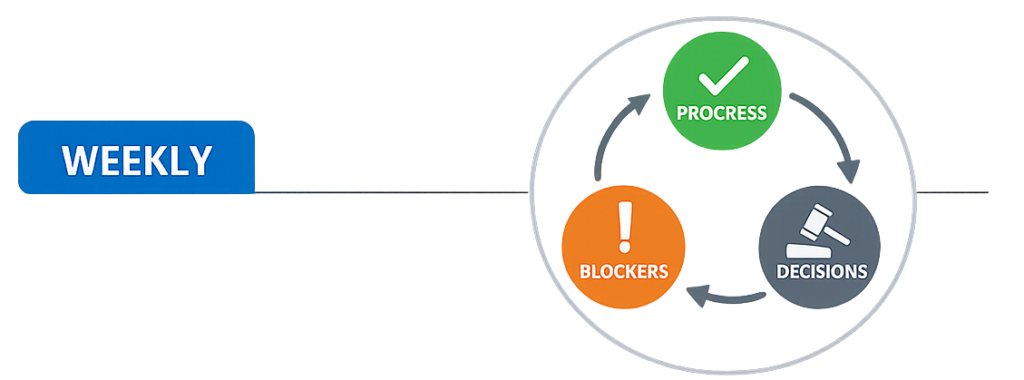
The answer is a few clear gates plus a steady execution rhythm.
4.1 A practical execution rhythm
This rhythm reduces “panic escalations” because decisions have a predictable home.
CEO overload is not a personal weakness. It is a system signal.
When escalation becomes the culture:
Healthy execution makes the CEO an architect of rhythm and clarity, not the emergency service.
This is the core business strategy execution framework suitable for mid-sized South African businesses and the backbone of effective strategy execution consulting in South Africa.
A strategy is only useful if people can repeat it and act on it without a slide deck. Make it simple. When the strategy is clear and short, it becomes a daily guide, not a yearly event.
Priorities become real when they are translated into outcomes, initiatives, owners, and first steps. For each priority, define what “done” looks like, choose the few initiatives that will move the needle, and assign one accountable leader.
Execution slows when decision rights are unclear. When decision rights are visible, managers lead with confidence, escalations drop, and speed returns to the business.
Governance gates are simple checkpoints where decisions happen fast and consistently. This prevents projects from drifting, reduces surprise crises, and creates a predictable rhythm where the right decisions happen at the right level.
A dashboard turns execution into something you can see, not guess. Keep it light. When the dashboard is reviewed weekly, problems surface early, making them cheaper to fix.
Under stress, teams either speak up early or hide problems until they explode. When people feel safe to report reality, leadership can act sooner, decisions improve, and performance becomes repeatable.
Symptoms: everything “urgent,” pricing exceptions escalated to the CEO, projects drifted.
Fix: reduced priorities to 4, clarified pricing/credit decision rights, installed a weekly rhythm, and created a basic dashboard.
Result pattern: fewer escalations, faster decisions, less CEO overload.
Reality: energy instability + supplier delays increased downtime and rework; customer complaints rose.
Symptoms: strategy said “margin + quality,” but daily behaviour was overtime and firefighting.
Fix:
Result pattern: fewer repeat defects, faster problem closure, more stable delivery, calmer leadership load.
A strategy execution consulting partner should not sell you motivation. They should help you build an execution system that survives real pressure: energy disruptions, cash constraints, talent gaps, and fast-moving customer demands. Start by checking whether they can translate strategy into operating design: decision rights, governance gates, meeting cadence, and a practical dashboard. Ask for proof that they have reduced CEO overload by redesigning escalation rules and strengthening middle-management ownership.
Look for a partner who is comfortable with the detail without creating bureaucracy. Insist on visible outputs within 30–45 days: a one-page strategy map, a prioritised initiative portfolio, a decision-rights matrix, and a weekly execution rhythm that forces decisions. Finally, pay attention to trust. Execution work surfaces conflict. You need a partner who can hold leaders accountable while protecting psychological safety, because early honesty prevents late crises.
Strategy execution is not motivation. It is an operating system.
In mid-sized South African businesses, execution wins when:
If you want support turning this into a working operating rhythm (not another document), Klaen Consultants can help you. Book a 30 min session with Klaen Consultants to review your current rhythm and determine how we can assist you.